MIST
Magnetosphere, Ionosphere and Solar-Terrestrial
Latest articles
- 2026 MIST Council Election Results
- Do Solar Energetic Particle events impact lower-atmospheric temperatures on Mars?
- How Can Turbulence Improve Space Weather Forecasts?
- Regression to the mean can explain saturation of geomagnetic storms
- Temporal Variability of Saturn's H2 Dayglow and Northern Aurora Observed by Hisaki and Cassini
Latest news
2026 MIST Council Election Results
It is our pleasure to announce the results of the latest MIST Council Election.
- Samuel Wharton (University of Leicester) is elected for a 3 year term as a MIST Councillor
- Jewel Abbey Relampagos (Lancaster University) is elected for a 1 year term as the MIST Student Representative
In addition, due to concerns from the community regarding the ongoing UKRI/STFC funding situation, MIST Council have also decided to charter Mark Lester (University of Leicester) as an additional councillor to inform and steer the council in matters related to this specific brief, as set out in Article 4.5 of the MIST Charter.
We would like to congratulate everyone on their new roles. The full composition of Council can be found on the MIST website (https://www.mist.ac.uk/community/mist-council). We would like to thank all the candidates for putting themselves forward and everyone who took part in the voting. We received votes from 132 people which represents a turnout of 21.5% of people registered to receive the MIST emailing list.
Finally, MIST Council would like to extend their thanks and gratitude to our outgoing members: Fiona Ball and Georgios Nicolaou. We would also like to say a special thank you to Andy Smith who was co-opted to be on MIST council while Rosie Johnson was on maternity leave, thank you for all of your hard work.
Open Letter Ready For Signatories
Protect MIST Science! Sign the MIST Community Open Letter on the STFC funding cuts!
https://sites.google.com/view/uk-mist-community-open-letter
Statement from MIST Council regarding the STFC Funding Situation
Statement from MIST Council regarding the STFC Funding Situation
MIST Council is deeply concerned by the ongoing STFC funding uncertainty and its impact on our community and beyond.
The current combination of prospective delayed and reduced funding, together with already volatile financial situations at universities across the UK, is placing significant strain on research groups. In some cases, institutions may be unable to support researchers through gaps between projects, increasing precarity across the community and adding significant pressure on early-career researchers.
We are concerned that continued uncertainty risks accelerating a brain drain from the UK, as skilled researchers reconsider their future in a system offering limited stability. The loss of expertise at any career stage would have lasting consequences for UK space science.
What is going on?
For those that are unaware of the situation, it is complex and evolving. We suggest the following sources to get up to speed on the current developments.
https://ras.ac.uk/news-and-press/news/proposed-budget-cuts-catastrophe-uk-astronomy
What are we doing about it?
Behind the scenes, MIST Council is actively engaging with relevant parties to understand the scale of the challenge and to identify constructive ways forward.
- We are seeking seasoned members of the community to join MIST Council on a task force to help develop options and represent the needs of our community. If you would like to be involved, please reach out to us via the MIST Council email (This email address is being protected from spambots. You need JavaScript enabled to view it.) by the end of this week (13th February 2026).
- In addition to the task force, we want to provide an open forum for discussion and collective input among all members of the wider MIST community. We are exploring options and will be in touch as soon as possible with further details.
- We believe in working together in the face of the current challenges and we are collaborating with UKSP and others to strive for a fair and positive outcome for all. We are reaching out to members of the SSAP (Solar System Advisory Panel) to explore the hosting of a community town hall meeting, like the one already being organised by the AAP (Astronomy Advisory Panel), to provide an open forum for discussion and collective input.
What can you do to help?
There are several open letters representing people in various career stages that have been made available to sign. We encourage you to read the relevant letter(s) and to sign them if you support them:
- Fellowship Holders: https://advancedfellows-openletter-stfc.github.io/index.html
- Early Career Researchers: https://ecr-openletter-stfc.github.io/
The Royal Astronomical Society are also urging Fellows to lobby their MPs against the cuts, and have included a template letter that can be used to do so:
https://ras.ac.uk/news-and-press/news/ras-fellows-urged-lobby-against-unprecedented-cuts
MIST Council will continue to advocate for transparency, stability, and funding structures that recognise both the long-term nature of our science and the people who deliver it.
We thank you for your continued support in this period of uncertainty.
Please contact This email address is being protected from spambots. You need JavaScript enabled to view it. if you have further suggestions.
MIST Council
Announcement of New MIST Council 2025
We are very pleased to announce the following members of the community have been elected to MIST Council:
- Gemma Bower (University of Leicester), MIST Councillor
- Tom Elsden (University of St Andrews), MIST Councillor
- Cameron Patterson (Lancaster University), MIST Councillor
- Fiona Ball (University of Southampton), Student Representative
They will begin their terms in July 2025.
We thank outgoing MIST Council members: Maria Walach, Chiara Lazzeri and Emma Woodfield. Andy Smith will remain on council a little longer as a co-opted member to cover Rosie Johnson's maternity leave.
The current composition of Council can be found on our website (https://www.mist.ac.uk/community/mist-council).
Announcement of New MIST Councillors.
We are very pleased to announce the following members of the community have been elected unopposed to MIST Council:
- Rosie Johnson (Aberystwyth University), MIST Councillor
- Matthew Brown (University of Birmingham), MIST Councillor
- Chiara Lazzeri (MSSL, UCL), Student Representative
Rosie, Matthew, and Chiara will begin their terms in July. This will coincide with Jasmine Kaur Sandhu, Beatriz Sanchez-Cano, and Sophie Maguire outgoing as Councillors.
The current composition of Council can be found on our website, and this will be amended in July to reflect this announcement (https://www.mist.ac.uk/community/mist-council).
Nuggets of MIST science, summarising recent papers from the UK MIST community in a bitesize format.
If you would like to submit a nugget, please fill in the following form: https://forms.gle/DGNZiP7sA3e8U29ZA and we will arrange a slot for you in the schedule. Nuggets should be 100–300 words long and include a figure/animation. Please get in touch!
If you have any issues with the form, please contact This email address is being protected from spambots. You need JavaScript enabled to view it..
SpaceSSL – Automatic Encoding to Find Similar Observations
By Andy Smith (Northumbria University)
We often have large, unlabelled datasets in space physics, where the phenomenon of interest only appears rarely. Understanding the underlying physics of the system from rare observations is a challenge, and locating complementary, similar observations in large datasets can be prohibitively time consuming.
In this work we present an automated, self-supervised method by which the key information from two dimensional data can be encoded into a smaller vector representation. This representation (encoding/embedding) contains the key information describing the data; we can then use the distance between vectors to assess the similarity of the observations.
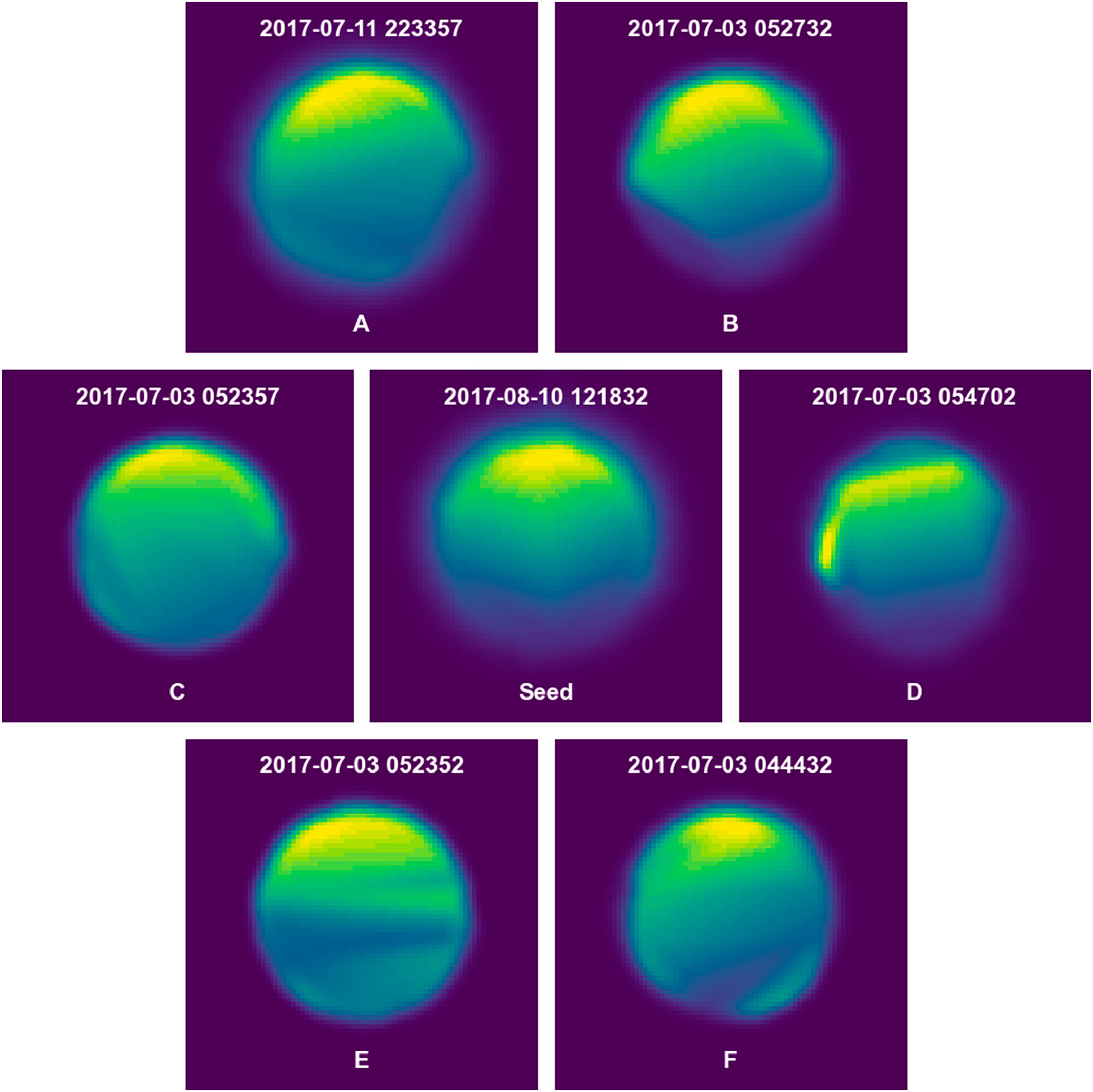
We showed the potential of this method with two example datasets – spacecraft in situ electron velocity distributions and auroral all sky images. For both datasets we provided the method with a library of over five thousand images, which were then effectively and automatically summarized by the model.
In the case of the electron distributions, we tested a “seed” image of a rare phenomena – corresponding to the region of space near the site of magnetic reconnection. In this region the electron distribution takes a characteristic crescent or arc-like shape [Figure 1, centre]. We can then extract the six closest partners of this image, using the distance between the embedding vectors. The two closest neighbours of the seed image (A and B in Figure 1) represent two separate previously published case study examples known to be close to the site of magnetic reconnection.
This method promises to be a useful tool in locating interesting phenomena in large datasets, providing an efficient method for moving from case studies to thorough statistical surveys. Code to train an example model is available at: https://github.com/SmithAndy005/SpaceSSL .
See publication for details:
Smith, A. W., Rae, I. J., Stawarz, J. E., Sun, W. J., Bentley, S., & Koul, A. (2024). Automatic encoding of unlabeled two dimensional data enabling similarity searches: Electron diffusion regions and auroral arcs. Journal of Geophysical Research: Space Physics, 129, e2023JA032096. https://doi.org/10.1029/2023JA032096
The Nonlinear Evolution of Whistler-Mode Chorus waves: How Modulation Instabilities Can Be a Route to Tone Formation
By Daniel Ratliff (Northumbria University)
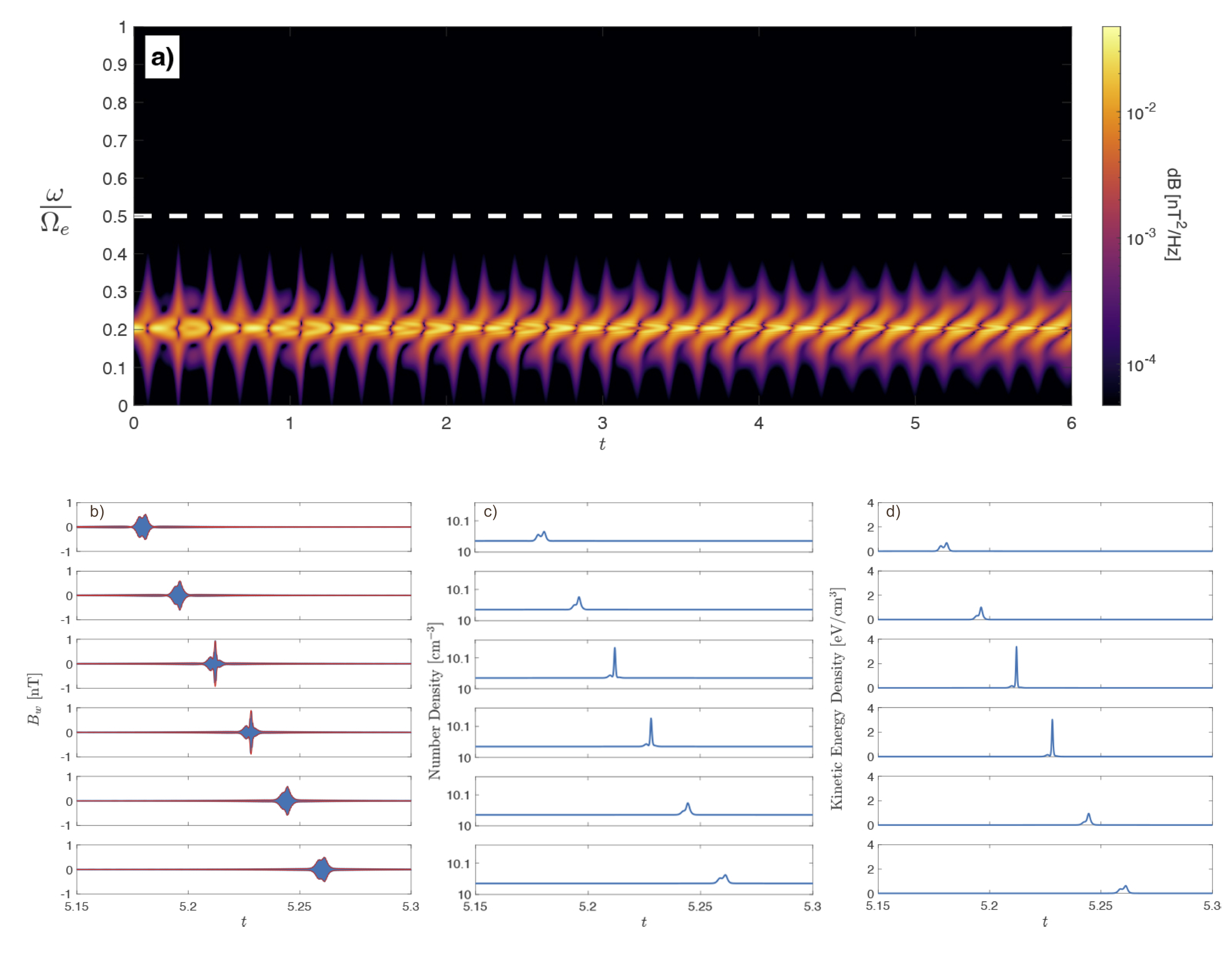
Whistler-Mode Chorus (WMC) waves remain a key contributor to the processes underpinning space weather modelling and have garnered considerable interest for their unique frequency properties (known as tones, where the frequency will rise or fall coherently). This role and phenomena are in no small part due to the interplay between these waves and the electrons present in the magnetosphere. At present, these wave particle interactions are difficult to model simultaneously effectively, and we normally restrict ourselves to the effect of one on the other – either a known wave is used to develop a particle distribution, or a supplied particle distribution generates WMC waves. Can we develop models that do both? And furthermore, can we develop a model that can reproduce this interesting set of frequency dynamics?
In our paper, we use formal perturbation techniques to derive a reduced, nonlinear model for (parallel propagating) WMC that is driven by wave-particle interactions via ponderomotive effects. Our first attempt, the famous Nonlinear Schrodinger equation, fails to generate tones – and so we dig a little deeper to find a term responsive for nonlinear frequency shifts. Surprisingly, this new term responsible for tones vanishes precisely at the WMC band gap at half the electron gyrofrequency, and provides a theoretical basis for why such a bandgap exists. By exploring this model numerically, we also find that there are cases where this tonal behaviour comes with a significant enhancement of the electron kinetic energy – so maybe the magnetosphere’s dawn chorus is at times a swan song in disguise?
See publication for further information:
Ratliff DJ, Allanson O. The nonlinear evolution of whistler-mode chorus: modulation instability as the source of tones. Journal of Plasma Physics. 2023;89(6):905890607. doi:10.1017/S0022377823001265
Modeling and Observations of the Effects of the Alfvén Velocity Profile on the Ionospheric Alfvén Resonator
By Rosie Hodnett (University of Leicester)
The Ionospheric Alfvén Resonator (IAR) occurs when Alfvén waves partially reflect from boundaries in the ionosphere, towards the bottom of the ionosphere and above the F-region peak. The frequencies of the IAR are strongly controlled by the plasma mass density in the ionosphere, which is not uniform.
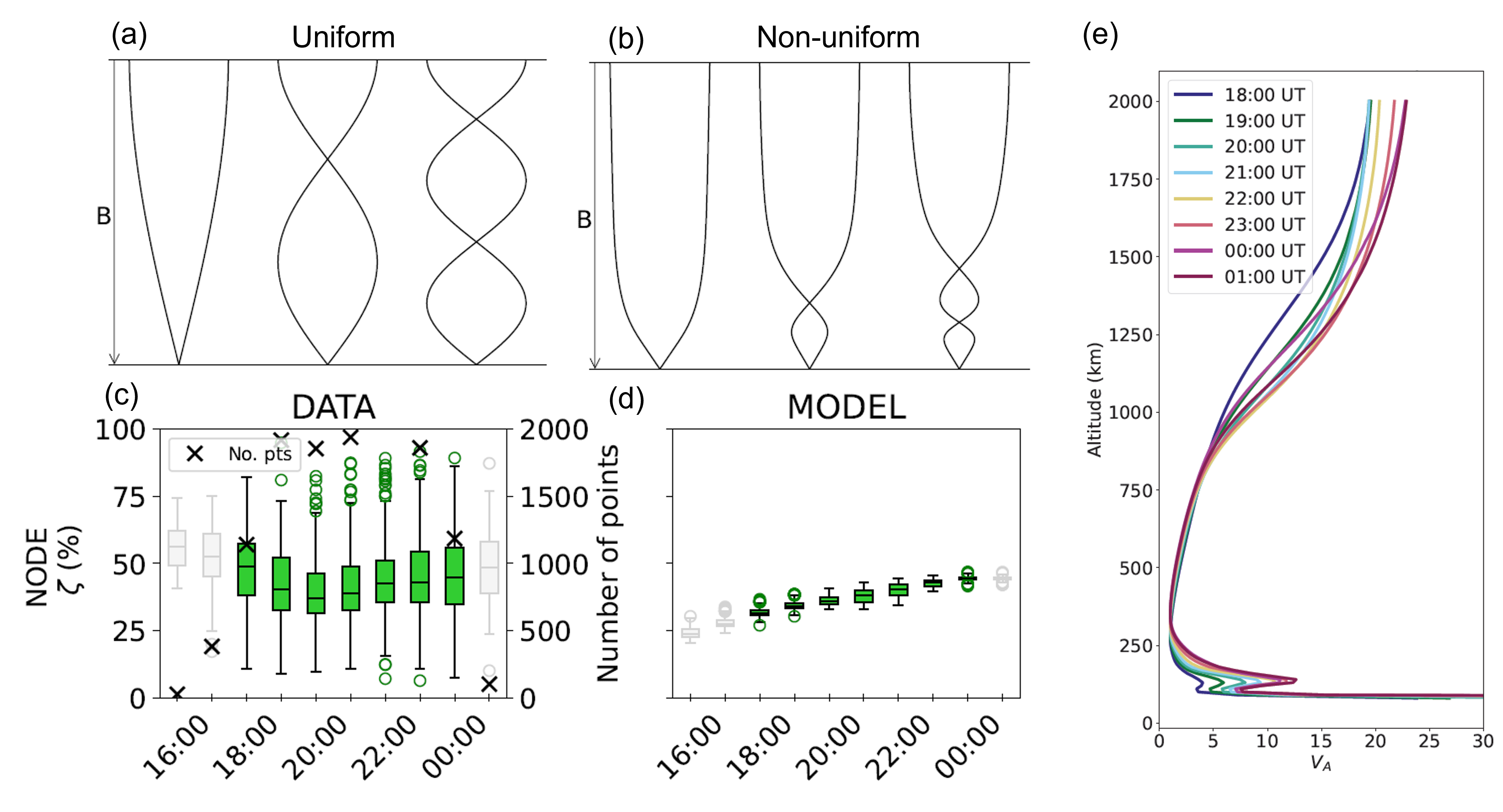
We have observed IAR in induction coil magnetometer data at Eskdalemuir, UK (BGS site), and extracted the harmonic frequencies for nine years of data. To model the harmonic frequencies, we used the International Reference Ionosphere and the International Geomagnetic Reference Field to model Alfvén velocity profiles. By solving a one-dimensional wave equation, we modelled the first five harmonics of the IAR for times where we had data. The wave structure of the electric field for a uniform case is shown in panel (a), and the resulting modelled harmonics for a non-uniform case is shown in panel (b). We modelled the frequencies with the lower boundary condition of the electric field of the wave being a node (shown in the figure below) and an antinode. By looking at the percentage difference between the fundamental frequency and the average separation of the harmonics (ζ) for both the node and antinode models and comparing this with the data, we find that the lower boundary is closest to being a node. ζ is presented for the node case, with UT, in panels (c) and (d), which show the data and the model respectively, binned by UT. The trend of increasing ζ towards midnight is due to changing Alfvén velocity profiles (shown in panel (e)), and suggests that the ionosphere is becoming more non-uniform. As such, measurements of IAR could be used to gain insight into the shape of the Alfvén velocity profile of the ionosphere.
BGS induction coil magnetometer data, search for 'induction coil': https://webapps.bgs.ac.uk/services/ngdc/
accessions/index.html
See publication for further information:
Hodnett, R. M., Yeoman, T. K., Beggan, C. D., & Wright, D. M. (2024). Modeling and observations of the effects of the Alfvén velocity profile on the Ionospheric Alfvén Resonator. Journal of Geophysical Research: Space Physics, 129, e2023JA032308. https://doi.org/10.1029/2023JA032308
Topology of turbulence within collisionless plasma reconnection
Bogdan Hnat (University of Warwick)
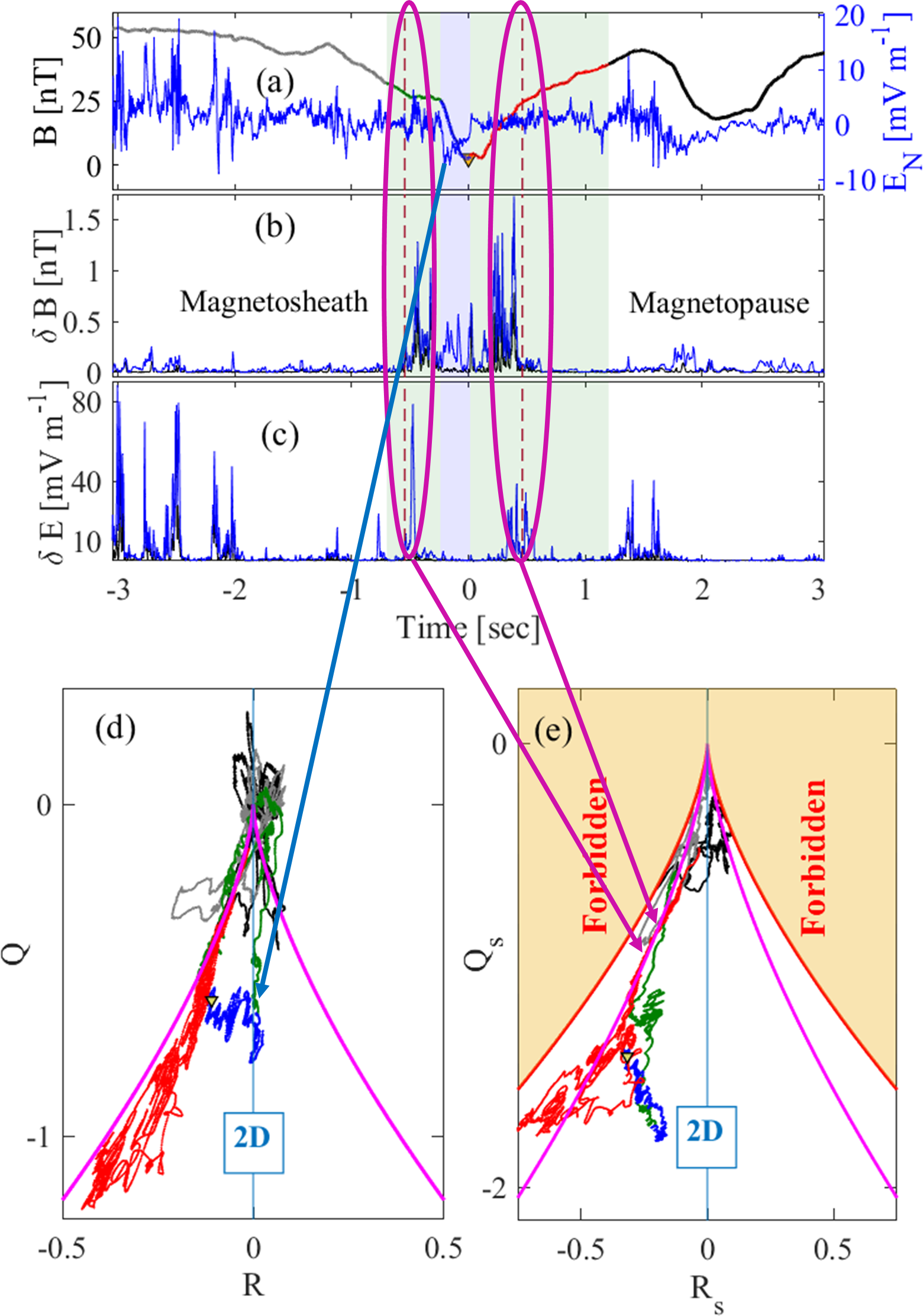
Collisionless magnetic reconnection [1] and plasma turbulence [2] are fundamental mechanisms that transfer energy across scales and between electromagnetic fields and particles. Stretched turbulent vortices and thin reconnection current sheets are prime sites of plasma heating and particle acceleration. Magnetic field line topology is central to both these processes.
We have classified the magnetic field topology observed as the four MMS spacecraft fly through a well resolved reconnection site. The MMS spacecraft separation defines a spatial 'yardstick', which is of order of the ion inertial range di, for sampling magnetic field topology. However, spatial variation of the topology is indirectly captured on a much finer spatial scale due to high time resolution of the magnetic field measurements, 8192 samples per second.
We find two distinct types of the magnetic field line topology near and at the electron dissipation region (EDR). At the edges of the EDR turbulent-like topology, identical to the topology of stretched vortices in hydrodynamic turbulence, is dominant. It coincides with large high-frequency electromagnetic perturbations. At the EDR the topology departs from turbulence and the structures appear to be two-dimensional, coinciding with suppression of electromagnetic fluctuations. The topology of the magnetic field line directly orders electron acceleration and heating. Suprathermal electrons are absent where turbulent-like topology dominates, but the bulk electron temperature anisotropy is enhanced. Reduced two-dimensional topology at the EDR coincides with the suprathermal electrons. The turbulent-like topology can arise in EMHD in scales smaller than electron inertial scale when vorticity dominates the dynamics. We find that vorticity is indeed dominant at all times within our interval.
References:
[1] J. Birn, E.R. Priest, Reconnection of Magnetic Fields: Magnetohydrodynamics and Collisionless Theory and Observations (Cambridge University Press, New York, 2007).
[2] Matthaeus, W.H. and Velli, M.,Space Science Reviews, 160(1), pp.145-168 (2011).
See publication for further information:
Hnat, Bogdan, Sandra Chapman, and Nicholas Watkins. "Topology of turbulence within collisionless plasma reconnection." Scientific Reports 13.1 (2023): 18665.
Plasma vorticity in the high-latitude ionosphere
By Gareth Chisham (British Antarctic Survey)
Measurements of ionospheric plasma flow vorticity can be used for studying ionospheric plasma transport processes, such as convection and turbulence, over a wide range of spatial scales. This study presents an analysis of probability density functions (PDFs) of ionospheric vorticity for selected regions of the northern hemisphere high-latitude ionosphere as measured by the Super Dual Auroral Radar Network (SuperDARN) over a 6-year interval (2000-2005 inclusive). Making certain assumptions, the observed asymmetric vorticity PDFs can be decomposed into two separate components: (1) A single-sided function that results from the large-scale vorticity inherent in the ionospheric convection pattern, driven by magnetic reconnection; (2) A symmetric double-sided function that results from meso-scale vorticity that derives from fluid processes such as turbulence, and from measurement uncertainties.
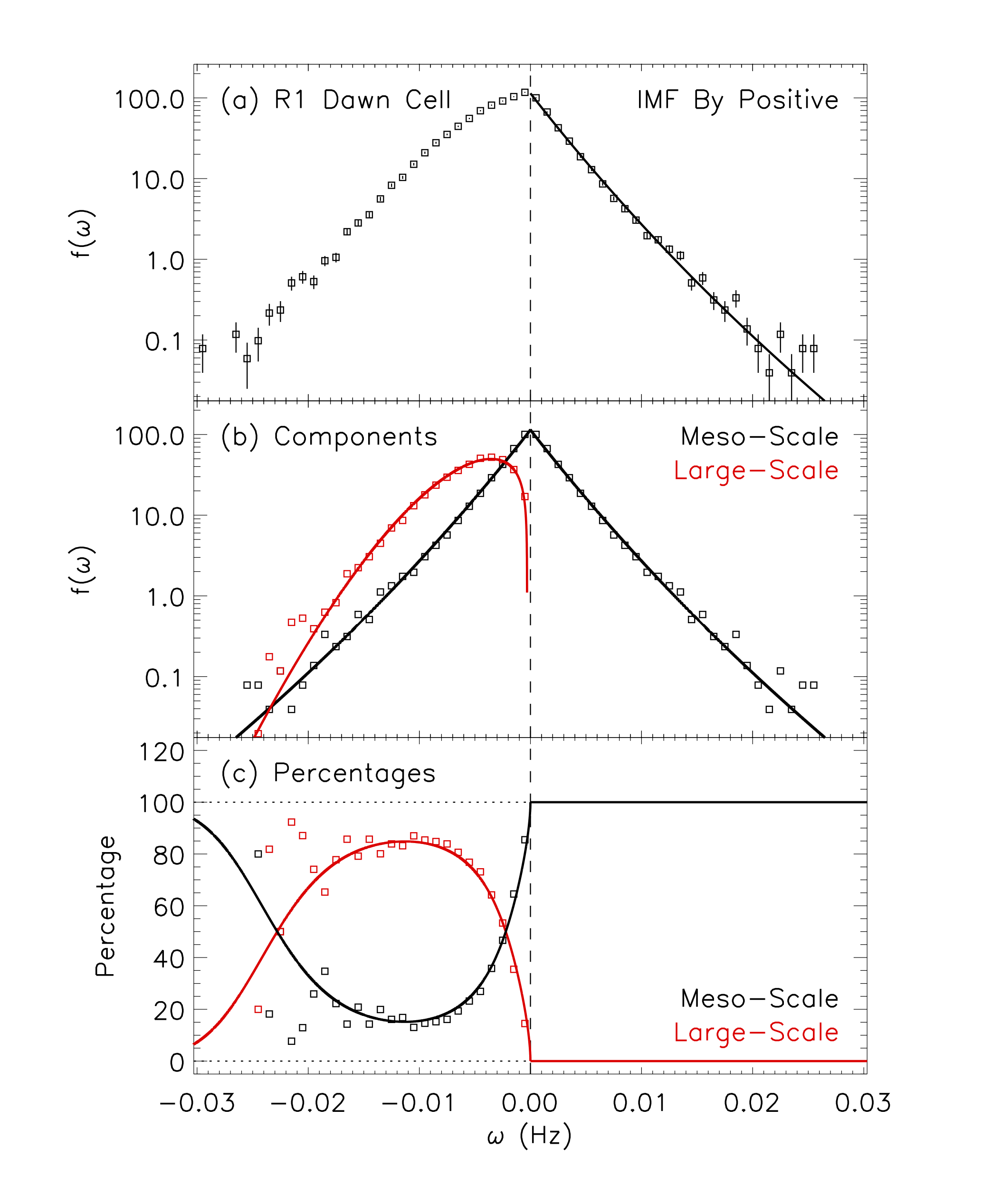
Being able to model ionospheric vorticity in this way will help to improve models of ionospheric plasma flow that are often used in larger-scale system models. At the present time, these plasma flow models typically only consider the larger-scale convection flow. Our observation of a significant meso-scale flow vorticity component due to turbulence will have implications for the fidelity of these models.
See paper for further details: Chisham, G. and Freeman, M. P. (2023). Separating contributions to plasma vorticity in the high-latitude ionosphere from large-scale convection and meso-scale turbulence. Journal of Geophysical Research: Space Physics, 128, e2023JA031885, https://doi.org/10.1029/2023JA031885.