MIST
Magnetosphere, Ionosphere and Solar-Terrestrial
Quantifying uncertainty in near-Earth solar wind measurements (OMNI versus Cluster)
By Neil Rogers (Lancaster University)
Many of us use the NASA “OMNI” database, which takes measurements from spacecraft (e.g., ACE or Wind) near the L1 Earth-Sun Lagrange point and uses them to predict solar wind conditions near the Earth’s bow shock nose. The question is: How accurate are these OMNI predictions? This is particularly topical given recent studies showing that measurement uncertainty could explain saturation in magnetospheric responses to solar wind driving (e.g., Sivadas et al. (2026), Nature, https://doi.org/10.1038/s41586-026-10757-4). We have compared 1-min resolution OMNI predictions of plasma density, velocity, and magnetic field with concurrent ‘ground truth’ measurements from two ESA Cluster spacecraft when they were located in the solar wind in years 2001 - 2023. After calibrating ‘systematic’ linear (instrumental) biases between pairs of spacecraft, we quantified and parameterised probability density functions (PDF) of the ‘stochastic’ differences between OMNI and Cluster. We found that many of these PDFs had a very narrow central peak (i.e., most differences were close to zero) but had ‘heavier tails’ in comparison with the Normal distribution (i.e., a greater likelihood of the largest differences). The Student’s-t distribution is a good fit for these cases, although we found the five-parameter Generalised Hyperbolic distribution provides the best characterisation of the rarest and largest differences (the outermost tails of the PDFs). Our paper provides a full quantification of both systematic and stochastic uncertainties, which could be used to place more realistic uncertainty bounds on analyses and forecasts that rely on OMNI data. Our database of times for which Cluster spacecraft were in the solar wind (~ 5000 hours) at various distances beyond the bow shock is also available to download: https://doi.org/10.5281/zenodo.18390327.
See publication for more details:
Rogers, N. C., Wild, J. A., & Grocott, A. (2026). Quantifying uncertainty in OMNI solar wind measurements projected from L1 to the Earth's bow shock. Journal of Geophysical Research: Space Physics, 131, e2026JA035221. https://doi.org/10.1029/2026JA035221
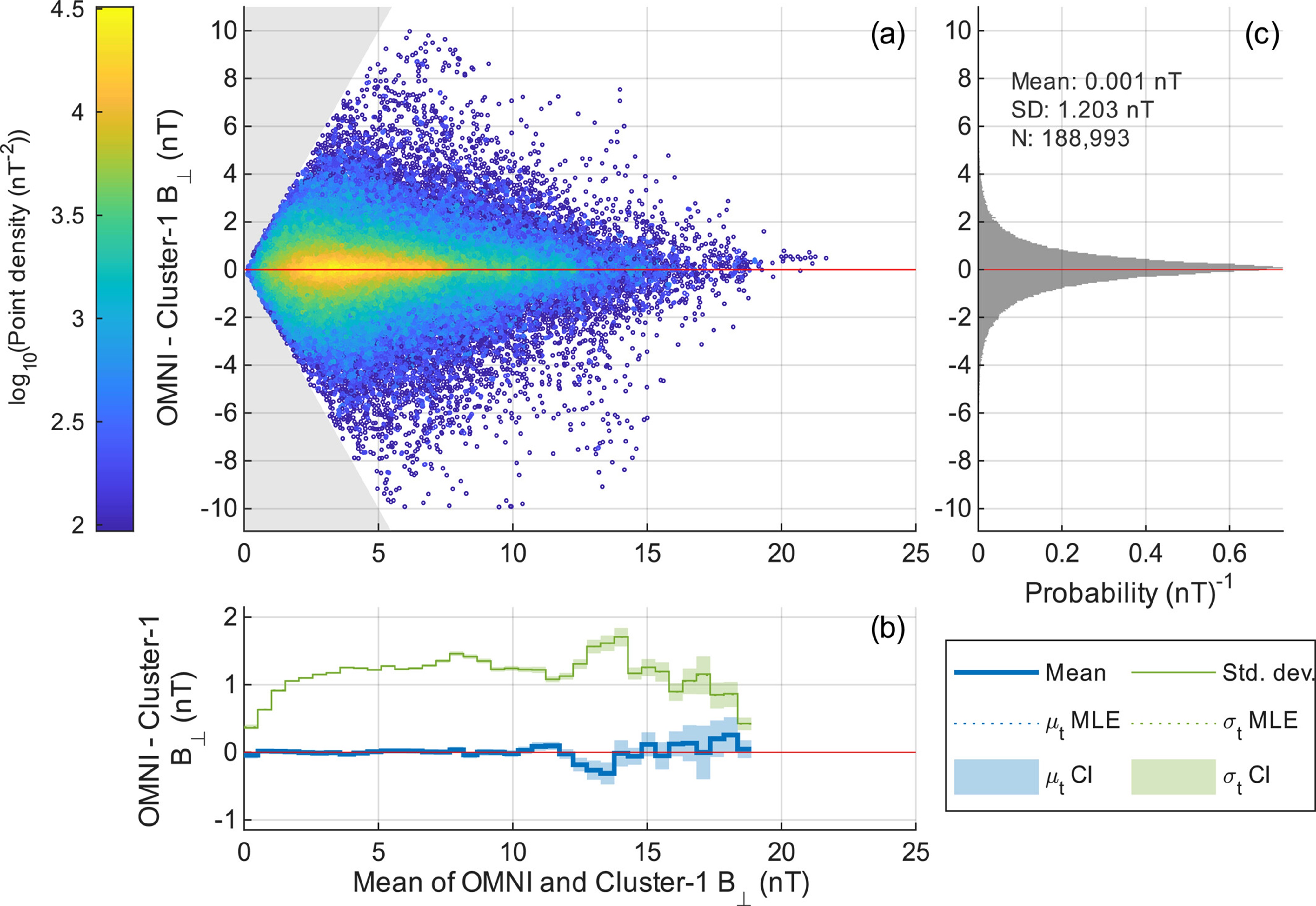
(a) Errors (OMNI minus Cluster-1) in the interplanetary magnetic field strength perpendicular to the Sun-Earth axis for all minutes in years 2001-2023. (b) Binned means and standard deviations of data in panel (a) and coefficients of fitted truncated Normal distributions (maximum likelihood estimates and 95% confidence intervals). (c) PDF of data in panel (a).
2026 MIST Council Election Results
It is our pleasure to announce the results of the latest MIST Council Election.
- Samuel Wharton (University of Leicester) is elected for a 3 year term as a MIST Councillor
- Jewel Abbey Relampagos (Lancaster University) is elected for a 1 year term as the MIST Student Representative
In addition, due to concerns from the community regarding the ongoing UKRI/STFC funding situation, MIST Council have also decided to charter Mark Lester (University of Leicester) as an additional councillor to inform and steer the council in matters related to this specific brief, as set out in Article 4.5 of the MIST Charter.
We would like to congratulate everyone on their new roles. The full composition of Council can be found on the MIST website (https://www.mist.ac.uk/community/mist-council). We would like to thank all the candidates for putting themselves forward and everyone who took part in the voting. We received votes from 132 people which represents a turnout of 21.5% of people registered to receive the MIST emailing list.
Finally, MIST Council would like to extend their thanks and gratitude to our outgoing members: Fiona Ball and Georgios Nicolaou. We would also like to say a special thank you to Andy Smith who was co-opted to be on MIST council while Rosie Johnson was on maternity leave, thank you for all of your hard work.
Do Solar Energetic Particle events impact lower-atmospheric temperatures on Mars?
Press Release from NAM 2026
Work by Lana Williams (Lancaster University) was the subject of a press release at the National Astronomy Meeting 2026.
The press release can be read here: https://www.ras.ac.uk/news-and-press/research-highlights/nam-2026-solar-storms-may-alter-martian-weather-during-dust
Lana is also scheduled to give a talk at the Europlanet Science Congress 2026: https://meetingorganizer.copernicus.org/EPSC2026/EPSC2026-221.html
Please read below for details on this work.
Do Solar Energetic Particle events impact lower-atmospheric temperatures on Mars?
By Lana Williams (Lancaster University)
The martian atmosphere is sensitive to disturbances in interplanetary space due to the absence of a strong planetary magnetic field. Solar energetic particle (SEP) events comprise high-energy, electrically-charged sub-atomic particles and are produced during solar flares and coronal mass ejections. Previous work has shown that SEPs result in diffuse aurorae, disruption of radio propagation, the dispersion of atmospheric compounds, and the ionisation of atmospheric layers. In this study, we explore the relationship between SEP events and lower-atmospheric heating at Mars. Five SEP events with durations of four days or longer were identified in the years 2018-2021. Measurements from the Mars Atmosphere And Volatile EvolutioN (MAVEN) mission and the Trace Gas Orbiter (TGO) spacecraft are compared to atmospheric temperature profiles derived from the Mars Climate Database. Specifically, Mars’ lower-atmospheric temperature profiles before, during and after the SEP events are analysed. No strong evidence is found that indicates SEP events lead to the heating of Mars’ atmosphere. However, in the one case, a SEP event occurred concurrently with an expanding global dust storm. In this case, a clear heating effect is observed, but further research is required to attribute atmospheric temperature variations as a result of the global dust storms and SEP events where the two occur simultaneously.