MIST
Magnetosphere, Ionosphere and Solar-Terrestrial
How Can Turbulence Improve Space Weather Forecasts?
How Can Turbulence Improve Space Weather Forecasts?
By Cara Waters (Queen Mary University of London)
The auroral electrojet (AE) index is one of the key indicators of high latitude geomagnetic activity. Forecasting it from upstream solar wind conditions remains challenging due to nonlinear coupling and multiscale variability. To combat this, we test whether incorporating solar wind turbulence improves short timescale AE forecasts beyond models based on solely the mean solar wind and interplanetary magnetic field. We compare two gradient boosted decision tree (XGBoost) models using near-Earth solar wind observations from OMNI. The baseline model uses standard mean field, density and velocity parameters, while the turbulence-aware model adds measures of fluctuation amplitude, intermittency, energy partition, compressibility, and Alfvénic structure. Both models achieve a peak performance at short lead times, giving correlations above 0.8 at 60 minutes. However, the turbulence-aware model maintains forecasting skill for longer lead times. The turbulence-aware model also provides consistent improvements over both the baseline model and persistence. Critically, this model improves forecast robustness for high-impact events. Using cost-loss analysis, the baseline model provides decreasing economic value with increasing AE threshold. In contrast, the turbulence-aware model maintains an approximately constant threshold for positive economic value, indicating stable economic usefulness even for extreme AE conditions. Using interpretable machine learning techniques, we can show that the most important turbulence parameters for this at short timescales are fluctuations in Bz and the skew of these fluctuations, and at longer timescales it is the properties of the turbulence (cross helicity, compressibility, and residual energy). This demonstrates that turbulence provides complementary, scale-dependent information beyond mean solar wind parameters, improving both forecast performance and decision-relevant value for operational space weather applications.
See publication for more details:
Cara L. Waters, Christopher H. K. Chen, Mathew J. Owens (2026). Beyond Mean Solar Wind Conditions: Turbulence-Aware Forecasting of the AE Index. Space Weather, 24(7). https://doi.org/10.1029/2026SW005094

Potential economic value 𝑉 against cost/loss ratio 𝑟 for the base model in (a) and turbulence model in (b), for a range of thresholds of auroral electrojet (AE) between 800 and 1,200 nT. (c) The 𝑥-intercept of each of the curves plotted against the threshold AE index for the turbulence model (red circles) and the base model (blue squares).
Regression to the mean can explain saturation of geomagnetic storms
Regression to the mean can explain saturation of geomagnetic storms
By Maria-Theresia Walach (Lancaster University)
submitted on behalf of Nithin Sivadas (Goddard Space Flight Center/Catholic University of America)
The strength of the solar wind that ‘drives’ (transfers energy to) the magnetosphere is different from the measurements made by satellites at L1, upstream of the magnetosphere. This difference is due to random errors resulting from substantial uncertainty in the timing, evolution and structure of the solar wind. We questioned the premise on which the saturation theories were constructed, and wondered whether there is reliable evidence that the saturation effect is real. We therefore set out to understand and calculate how uncertainty in the input of a system (in this case, the solar wind) affects inferences from data about the response of the system (Earth).
Using data from the Wind, THEMIS, MMS, DoubleStar and Cluster spacecraft, we found that random errors in the reported strength of the solar wind that strikes Earth depend on the strength of the solar wind, which has a log normal probability distribution. We used a Monte Carlo error model to calculate the probable ‘true’ value behind each measurement of solar-wind strength. Unexpectedly, we found a saturation of these true values as the measurement values increased, which is similar to the effect observed in the data (Fig. 1a). In other words, the true value regresses to the mean and away from the measurement, owing to the nature of the random error and statistical properties of the solar-wind strength. Correcting for uncertainties in timing and magnitude reveals that the Earth’s response in the polar PCI index to solar wind driving is linear throughout, which means driving of the magnetospheric system can be twice as large as previously thought for extreme geomagnetic storms (Fig. 1b).
References:
Main paper: Sivadas, N., Sibeck, D., Subramanyan, V., Walach, M.-T., Ozturk, D. S., Ferdousi, B., Michotte de Welle, B., Regression to the mean can explain saturation of geomagnetic storms. Nature 655, 1143–1147 (2026). https://doi.org/10.1038/s41586-026-10757-4. https://rdcu.be/fwSqV
For the interested reader, we recommend the Extended Data and Figures sections and the Supplementary Information section, which hold a large proportion of content for this paper. For a quick synopsis, we recommend the editorial summary below.
Research briefing: https://doi.org/10.1038/d41586-026-02245-6
See publication for more details:
Sivadas, N., Sibeck, D., Subramanyan, V., Walach, M.-T., Ozturk, D. S., Ferdousi, B., Michotte de Welle, B., Regression to the mean can explain saturation of geomagnetic storms. Nature 655, 1143–1147 (2026). https://doi.org/10.1038/s41586-026-10757-4. https://rdcu.be/fwSqV and Research Briefing, https://doi.org/10.1038/d41586-026-02245-6
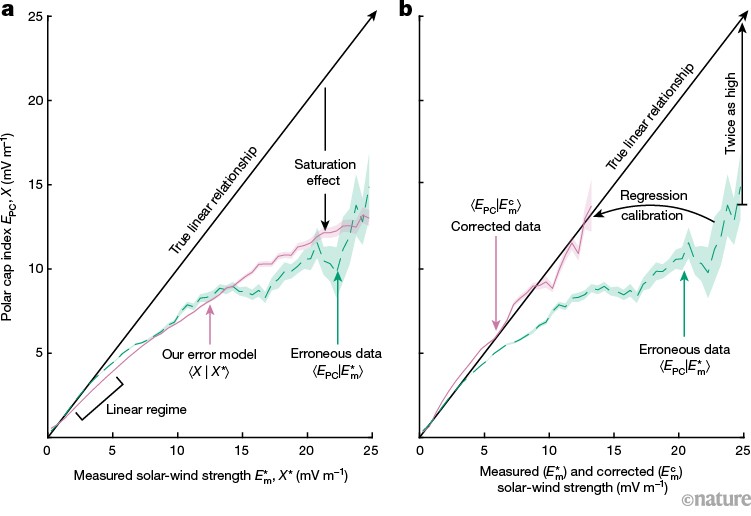
Uncertainty in measurements of solar wind explains the observed saturation of geomagnetic activity. a, Observations from 1995 to 2019 (green) indicate that, on average, the polar cap index (EPC, a measure of Earth’s geomagnetic response to solar wind) saturates at measurements of large solar-wind strength (E*m). The result of our statistical approach, the Monte Carlo error model (pink), predicts the same saturation effect arising from uncertainty in the measurement of solar wind transferring energy to Earth’s magnetosphere, rather than a physical mechanism. X* and X are measured and ‘true’ solar-wind strengths from the error model. b, Correcting the effect of random errors in values of solar-wind strength shows that Earth’s geomagnetic response is linear (pink), where Ecm is the corrected solar-wind strength. Credit: Sivadas, N. et al./Nature (CC BY 4.0) (https://doi.org/10.1038/d41586-026-02245-6)
Temporal Variability of Saturn's H2 Dayglow and Northern Aurora Observed by Hisaki and Cassini
Temporal Variability of Saturn's H2 Dayglow and Northern Aurora Observed by Hisaki and Cassini
By Leah Clare (Lancaster University)
The ultraviolet (UV) emissions from Saturn are composed of the dayglow from the sunlit atmosphere and the aurorae at the poles. Investigation into the daily variability of the dayglow remains somewhat unconstrained, particularly on timescales of weeks. Utilising coincident Hisaki and Cassini observations across ~3 weeks in 2014, we determine the temporal variability of the UV emitted power, assess the response of the dayglow to solar activity, and constrain the contribution from the northern aurora to the total emitted power. We find that the power varies by a factor of 2.26 over 23 days with Hisaki, and 1.29 over 17 days with Cassini. Upon separation of the northern auroral contribution with Cassini, the contribution is found to be between 10% - 26%. Additionally, the dayglow component displays a strong correlation with solar activity, confirming that the dayglow is controlled by the UV solar flux as shown by previous studies (Gustin et al., 2010; Liu & Dalgarno 1996). This study demonstrates the first analysis of the Saturn campaigns by Hisaki, allowing an assessment of the robustness of such a mission in observing outer planet targets. The multi-mission analysis confirmed that Hisaki was able to track the variability of the UV emissions from Saturn, with comparative trends to the Cassini data.
References:
Gustin, J., Stewart, I., Gérard, J. C., & Esposito, L. (2010). Characteristics of Saturn’s FUV airglow from limb-viewing spectra obtained with Cassini-UVIS. Icarus, 210(1), 270–283. https://doi.org/10.1016/j.icarus.2010.06.031
Liu, W., & Dalgarno, A. (1996). The Ultraviolet Spectrum of the Jovian Dayglow. The Astrophysical Journal, (462), 502–518.
See publication for more details:
https://doi.org/10.1029/2026JA035194
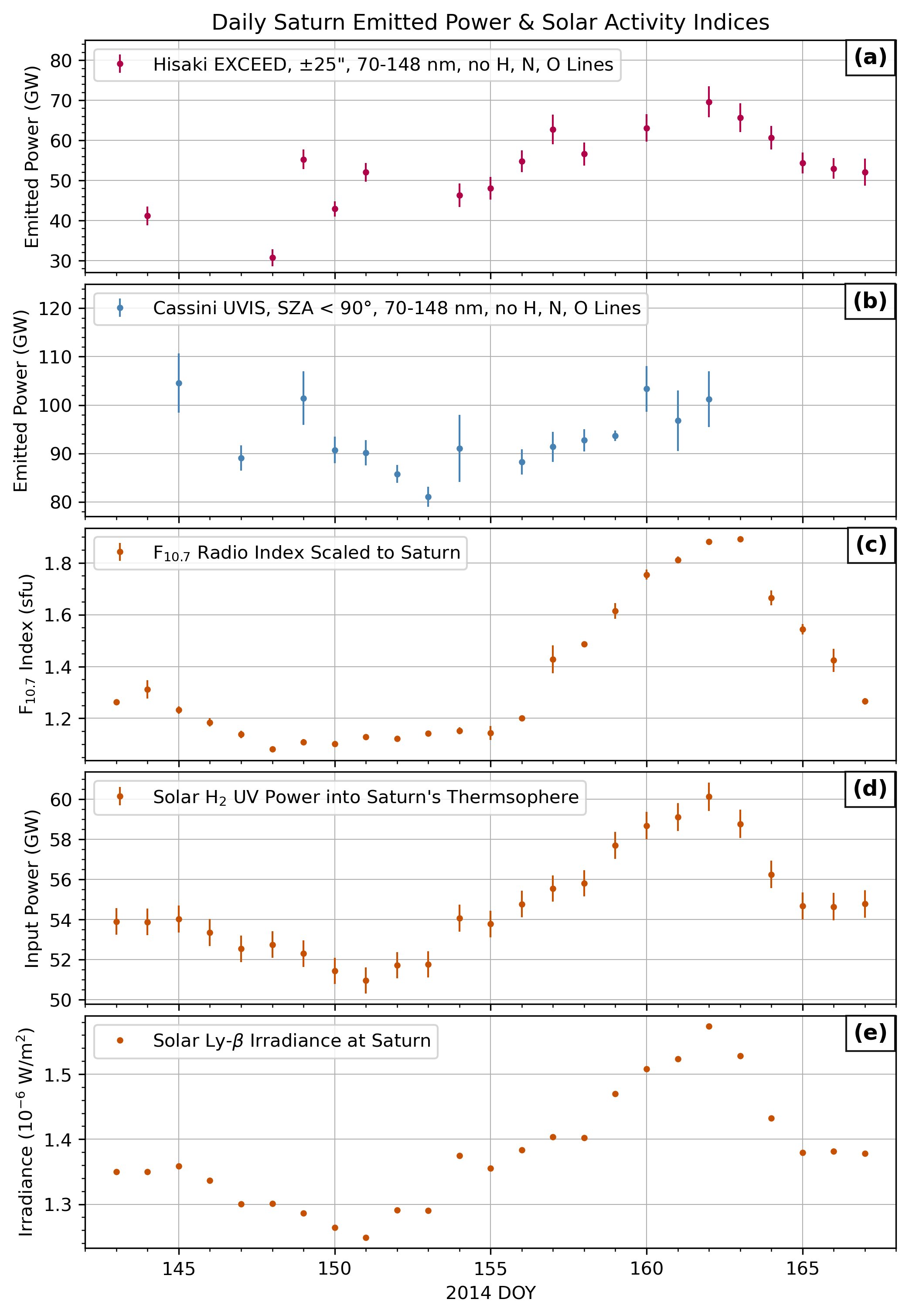
(a) The total emitted UV power obtained from Hisaki/EXCEED. The points are daily average H2 powers from 70 to 148 nm. (b) The total emitted UV power determined with Cassini UVIS; each point is the daily average H2 power for the wavelength range 70–148 nm. (c) The daily average solar F10.7 radio index, a proxy for EUV radiation, scaled to Saturn. Data from Space Weather Canada. (d) The solar EUV power into Saturn's thermosphere. Solar spectral irradiance data are obtained from LISIRD, which uses the Flare Solar Irradiance Model (Chamberlin et al., 2008) and Earth irradiance measurements. The calculation is from Gershman and DiBraccio (2024). (e) The solar H‐Lyman β irradiance at Saturn; data are obtained from LISIRD, which uses the Flare Solar Irradiance Model (Chamberlin et al., 2008) and Earth irradiance measurements.
Solar Activity References:
Chamberlin, P. C., Woods, T. N., & Eparvier, F. G. (2008). Flare irradiance spectral model (fism): Flare component algorithms and results. Space Weather, 6(5). https://doi.org/10.1029/2007SW000372
Gershman, D. J., & DiBraccio, G. A. (2024). Quantifying External Energy Inputs for Giant Planet Magnetospheres. Geophysical Research Letters, 51(15). https://doi.org/10.1029/2024GL109660