MIST
Magnetosphere, Ionosphere and Solar-Terrestrial
Latest articles
- Introducing XIM to Study the Spectral Properties of Solar Wind Charge Exchange at Earth’s Magnetospheric Boundaries
- Saturn's Auroral Dusk Sector Magnetosphere-Ionosphere Coupling During Cassini's Proximal Orbits
- A Multi-Event Comparison of dB/dt Resulting From Omega Band Aurora
- Can we Resolve Magnetosheath Jets with a Soft X-ray Imager?
- Russell-McPherron mechanism effect on space junk de-orbiting
Latest news
2026 MIST Council Election Results
It is our pleasure to announce the results of the latest MIST Council Election.
- Samuel Wharton (University of Leicester) is elected for a 3 year term as a MIST Councillor
- Jewel Abbey Relampagos (Lancaster University) is elected for a 1 year term as the MIST Student Representative
In addition, due to concerns from the community regarding the ongoing UKRI/STFC funding situation, MIST Council have also decided to charter Mark Lester (University of Leicester) as an additional councillor to inform and steer the council in matters related to this specific brief, as set out in Article 4.5 of the MIST Charter.
We would like to congratulate everyone on their new roles. The full composition of Council can be found on the MIST website (https://www.mist.ac.uk/community/mist-council). We would like to thank all the candidates for putting themselves forward and everyone who took part in the voting. We received votes from 132 people which represents a turnout of 21.5% of people registered to receive the MIST emailing list.
Finally, MIST Council would like to extend their thanks and gratitude to our outgoing members: Fiona Ball and Georgios Nicolaou. We would also like to say a special thank you to Andy Smith who was co-opted to be on MIST council while Rosie Johnson was on maternity leave, thank you for all of your hard work.
Open Letter Ready For Signatories
Protect MIST Science! Sign the MIST Community Open Letter on the STFC funding cuts!
https://sites.google.com/view/uk-mist-community-open-letter
Statement from MIST Council regarding the STFC Funding Situation
Statement from MIST Council regarding the STFC Funding Situation
MIST Council is deeply concerned by the ongoing STFC funding uncertainty and its impact on our community and beyond.
The current combination of prospective delayed and reduced funding, together with already volatile financial situations at universities across the UK, is placing significant strain on research groups. In some cases, institutions may be unable to support researchers through gaps between projects, increasing precarity across the community and adding significant pressure on early-career researchers.
We are concerned that continued uncertainty risks accelerating a brain drain from the UK, as skilled researchers reconsider their future in a system offering limited stability. The loss of expertise at any career stage would have lasting consequences for UK space science.
What is going on?
For those that are unaware of the situation, it is complex and evolving. We suggest the following sources to get up to speed on the current developments.
https://ras.ac.uk/news-and-press/news/proposed-budget-cuts-catastrophe-uk-astronomy
What are we doing about it?
Behind the scenes, MIST Council is actively engaging with relevant parties to understand the scale of the challenge and to identify constructive ways forward.
- We are seeking seasoned members of the community to join MIST Council on a task force to help develop options and represent the needs of our community. If you would like to be involved, please reach out to us via the MIST Council email (This email address is being protected from spambots. You need JavaScript enabled to view it.) by the end of this week (13th February 2026).
- In addition to the task force, we want to provide an open forum for discussion and collective input among all members of the wider MIST community. We are exploring options and will be in touch as soon as possible with further details.
- We believe in working together in the face of the current challenges and we are collaborating with UKSP and others to strive for a fair and positive outcome for all. We are reaching out to members of the SSAP (Solar System Advisory Panel) to explore the hosting of a community town hall meeting, like the one already being organised by the AAP (Astronomy Advisory Panel), to provide an open forum for discussion and collective input.
What can you do to help?
There are several open letters representing people in various career stages that have been made available to sign. We encourage you to read the relevant letter(s) and to sign them if you support them:
- Fellowship Holders: https://advancedfellows-openletter-stfc.github.io/index.html
- Early Career Researchers: https://ecr-openletter-stfc.github.io/
The Royal Astronomical Society are also urging Fellows to lobby their MPs against the cuts, and have included a template letter that can be used to do so:
https://ras.ac.uk/news-and-press/news/ras-fellows-urged-lobby-against-unprecedented-cuts
MIST Council will continue to advocate for transparency, stability, and funding structures that recognise both the long-term nature of our science and the people who deliver it.
We thank you for your continued support in this period of uncertainty.
Please contact This email address is being protected from spambots. You need JavaScript enabled to view it. if you have further suggestions.
MIST Council

Announcement of New MIST Council 2025
We are very pleased to announce the following members of the community have been elected to MIST Council:
- Gemma Bower (University of Leicester), MIST Councillor
- Tom Elsden (University of St Andrews), MIST Councillor
- Cameron Patterson (Lancaster University), MIST Councillor
- Fiona Ball (University of Southampton), Student Representative
They will begin their terms in July 2025.
We thank outgoing MIST Council members: Maria Walach, Chiara Lazzeri and Emma Woodfield. Andy Smith will remain on council a little longer as a co-opted member to cover Rosie Johnson's maternity leave.
The current composition of Council can be found on our website (https://www.mist.ac.uk/community/mist-council).
Announcement of New MIST Councillors.
We are very pleased to announce the following members of the community have been elected unopposed to MIST Council:
- Rosie Johnson (Aberystwyth University), MIST Councillor
- Matthew Brown (University of Birmingham), MIST Councillor
- Chiara Lazzeri (MSSL, UCL), Student Representative
Rosie, Matthew, and Chiara will begin their terms in July. This will coincide with Jasmine Kaur Sandhu, Beatriz Sanchez-Cano, and Sophie Maguire outgoing as Councillors.
The current composition of Council can be found on our website, and this will be amended in July to reflect this announcement (https://www.mist.ac.uk/community/mist-council).
Nuggets of MIST science, summarising recent papers from the UK MIST community in a bitesize format.
If you would like to submit a nugget, please fill in the following form: https://forms.gle/DGNZiP7sA3e8U29ZA and we will arrange a slot for you in the schedule. Nuggets should be 100–300 words long and include a figure/animation. Please get in touch!
If you have any issues with the form, please contact This email address is being protected from spambots. You need JavaScript enabled to view it..
Shapes of Electron Density Structures in The Dayside Mars Ionosphere
By Catherine Diéval, Department of Physics, Lancaster University, UK.
The dayside Mars ionosphere is thought to be reasonably well understood (see e.g. a review by Withers, 2009). The top of the ionosphere is influenced, among various factors, by localized crustal magnetic fields (e.g. Acuña et al., 1999), solar EUV and solar wind input, in the absence of a global magnetic moment. However a peculiar ionospheric feature is still the subject of ongoing research: non-horizontal electron density structures are regularly observed in localized areas with strong and near vertical crustal magnetic fields, in the topside ionospheric levels remotely sampled by the MARSIS radar (Picardi et al., 2004) onboard the Mars Express orbiter (e.g. Andrews et al. 2014; Diéval et al., 2015; Duru et al., 2006; Gurnett et al., 2005). These structures are detectable via oblique echoes returned to the radar after it sends a radio wave pulse through the ionosphere.The reflectors often appear at higher apparent altitude than the surrounding ionosphere, and so are nicknamed "bulges".
Previous studies also used radar returns uncorrected for signal dispersion. Actually, the group velocity of the radio waves varies with the refractive index of the plasma layers encountered, until reflection occurs. The apparent ranges of the received echoes are calculated using the time delays of the echoes and assuming the speed of light in vacuum. However this leads to overestimating the ranges,so interpretations on the shape of the structures based on these are uncertain.
Our work (Diéval et al., 2018), is a statistical study using timeseries of electron density profiles (electron density function of altitude, corrected for signal dispersion) to study the shape of 48 structures, in their full frequency (thus altitude) range, during the period that Mars Express passes over them.
Figure 1 shows that at any frequency, the most frequent shape is the bulge, dwarfing three other types of detected shapes: dips, downhill slopes and uphill slopes. All these shapes are inclined, thus able to reflect oblique echoes. Interestingly, bulges were reproduced in simulation results of Matta et al. (2015).
For more information, see the paper below:
Diéval, C., Kopf, A. J., & Wild, J. A. (2018). Shapes of magnetically controlled electron density structures in the dayside Martian ionosphere. Journal of Geophysical Research: Space Physics, 123, 3919–3942. https://doi.org/10.1002/2017JA025140

Figure 1: Distribution of the four simplest shapes of structures as a function of frequency, for the 48 events, displayed as colored symbols: bulges (red dots), dips (black diamonds), uphill slopes (blue ‘x’), downhill slopes (green ‘+’). Data points at frequency levels within in the sensitivity gaps are not displayed.
Plasma Heating From Dipolarizations in Saturn's Magnetotail
By Andrew Smith, Department of Physics and Astronomy, University of Southampton, UK.
Magnetic reconnection in a planet's magnetotail allows the stretched field to snap back towards the planet, carrying with it a bundle of plasma. This is known as a dipolarization front, which often manifest in spacecraft data as rapid rotations of the magnetic field accompanied by a change in the local plasma character. Dipolarization fronts have been observed at Earth, Mercury, Jupiter and Saturn and are thought to be linked to bright auroral displays.
We performed a large automated survey of Cassini data, identifying 28 intervals when the spacecraft was in the path of dipolarization fronts sweeping towards Saturn. The changes in plasma properties were investigated, along with the supra-thermal composition. A large dawn-dusk asymmetry was present in the observations, with 79% of the events located post-midnight. Figure 1 shows the change in plasma characteristics from that preceding the front (a) to within the dipolarizing material (b). All of the identified events showed an increase in the electron temperature and a coupled reduction in the electron density. Figures 1c and (d) show the relative change in temperature and density respectively. Overall, the temperature was found to increase by factors between 4 and 12, while the density dropped by factors of 3-10. The variable plasma properties are thought to be linked to a variable reconnection location, particularly post-midnight.
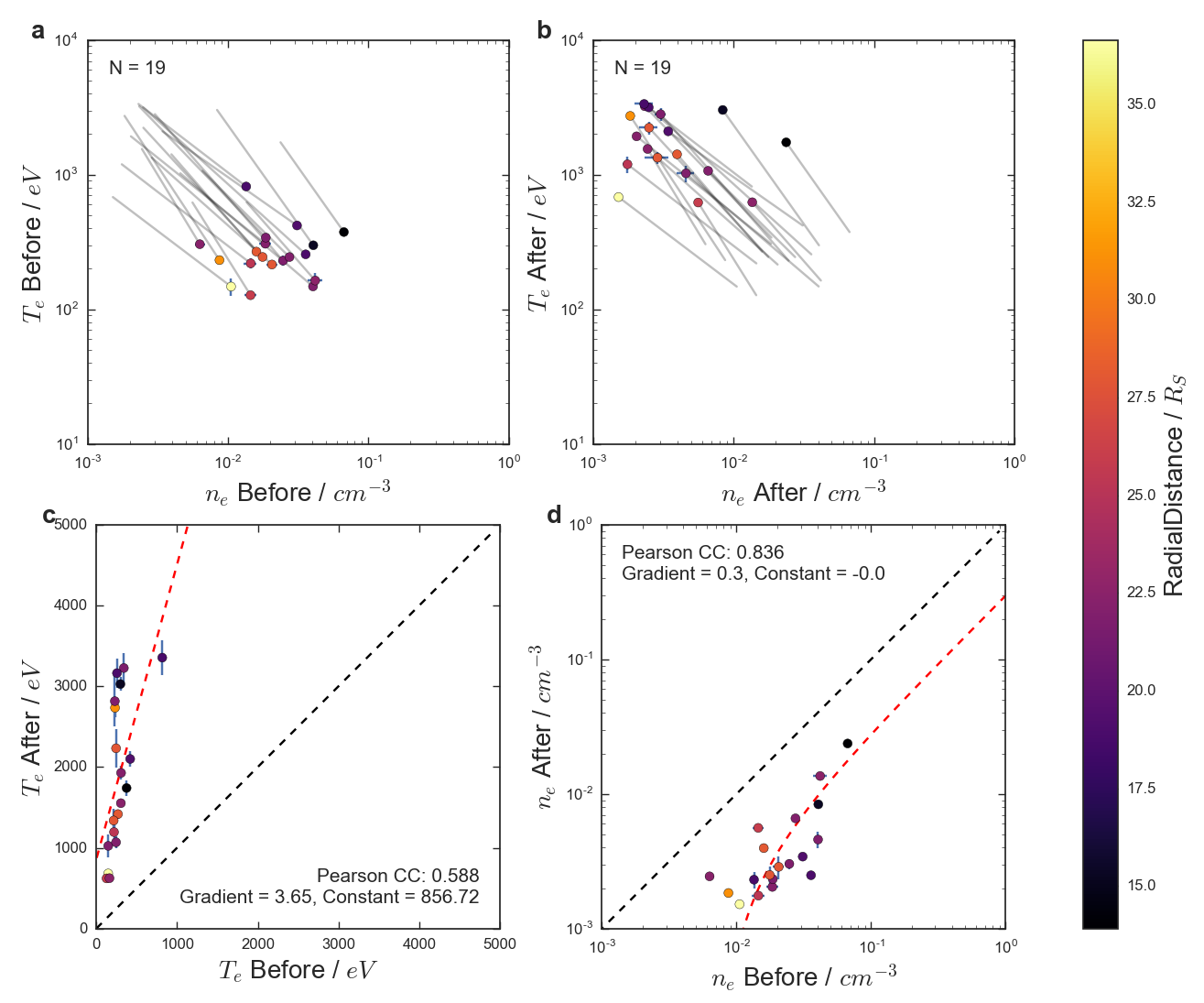
Figure 1: Panels (a) and (b) show the electron density plotted aainst the electron temperature for before (a) and after (b) the dipolarization front. These panels are plotted on the same axes scale for direct comparison. The gray lines indicate how the events move in density-temperature space. Panels (c) and (d) show the electron temperature and density (respectively) before the front plotted against the electron temperature and density after the passage of the front. The points and error bars provided are the mean and standard error of the mean respectively. The diagonal black dashed line shows the location of $y = x$: where the points would lie if there was no change following the passage of the front. The red dashed lines indicate least squares linear fits to the data; the details of the fit parameters are provided on the panels. The color bar for all four panels indicates the radial distance at which the spacecraft encountered the event.
For more information, see the paper below:
Smith, A. W., Jackman, C. M., Thomsen, M. F., Sergis, N., Mitchell, D. G., & Roussos, E. (2018). Dipolarization fronts with associated energized electrons in Saturn's magnetotail. Journal of Geophysical Research: Space Physics, 123, 2714–2735. https://doi.org/10.1002/2017JA024904
The Association of High‐Latitude Dayside Aurora With NBZ Field‐Aligned Currents
By Jennifer Carter, Department of Physics and Astronomy, University of Leicester, UK
Under northward interplanetary magnetic field conditions, when the IMF Bz > 0 nT, non-filamentary auroral emissions may be seen within the dayside polar cap and separate from the main auroral oval. These emissions are associated with lobe reconnection occurring at the high-latitude magnetopause on open field lines. Two mechanisms have been proposed to explain these emissions. The first involves the precipitation of magnetosheath plasma at the footprint of the high-latitude reconnection site, resulting in a “cusp spot”. This cusp spot has been shown to move in response to the east-west (BY) orientation of the solar wind. The second mechanism associates the auroral emissions known as High-Latitude Detached Arcs (HiLDAs) with upward field-aligned currents inside the polar cap. Under northward IMF, twin-cell field-aligned currents (NBZ system) can be found inside of the main region 1-region 2 field aligned current system. Under the influence of positive IMF BY, the upward NBZ cell expands across the noon sector in the Northern Hemisphere, whereas under negative BY, the downward cell will enlarge. The reverse scenario occurs in the Southern Hemisphere for either BYdirection.
Previous observations of HiLDAs have been limited to the Northern Hemisphere for a small data set, and previous authors have linked this phenomenon to season, as the HiLDAs have only been detected during the summer. We used concurrent auroral observations from Defense Meteorological Satellite Program Special Sensor Ultraviolet Spectrographic Imager (SSUSI) experiment, and FAC distributions constructed from the Active Magnetosphere and Planetary Electrodynamics Response Experiment (AMPERE), from the Iridium telecommunication satellite constellation, to perform a large statistical study of HiLDAs under varying IMF for both hemispheres. We observe a patch of auroral emission that is co-located with the upward NBZ FAC in the dayside polar cap in both the Northern and Southern Hemispheres under northward IMF conditions.
We observe the HiLDA emission to move in response to changes in the IMF BYcomponent (e.g. Figure 1), whereby the HiLDAs are seen to move into the polar cap under positive BY, or be pushed up against, and therefore indiscernible from, the main auroral oval under negative BY(Northern Hemisphere case). We also support the hypothesis that these emissions are only detectable in the summer hemisphere, indicating a dependence on ionospheric conductivity via photoionisation in the predominantly sunlit hemisphere.
For more information, see the paper below:

Figure 1: Northern Hemisphere summer auroral emissions in the Lyman-Birge-Hopfield long band with overlaid field-aligned current contours, for the Northern (N, row a) and Southern (S, row b) Hemispheres. Clock angles are given in the left-hand column. Interplanetary magnetic field magnitudes are between 5 and 10 nT. Field-aligned current contours are overlaid for upward (red) and downward (turquoise) currents, at absolute magnitudes of 0.1 (solid line), 0.3 (dashed line), and 0.5 (dotted line) μA/m2.
Solar Wind Dependence of Magnetospheric Ultra-Low Frequency Plasma Waves
By Sarah Bentley, Department of Meteorology, University of Reading, UK
Ultra-low frequency plasma waves (ULF, 1-15 mHz) are implicated in the energisation and transport of radiation belt electrons. Therefore a description of magnetospheric ULF wave power in terms of driving parameters is highly desirable for radiation belt forecasting; in particular, we want to describe power in terms of solar wind properties, as the solar wind is the dominant driver behind these waves.
However, identifying solar wind driving parameters is severely hampered by the nature of the solar wind. All solar wind parameters are highly interrelated due to their common solar sources and the interactions within the solar wind between the Sun and Earth, resulting in the effect that all solar wind properties correlate so strongly with speed vswthat investigating their relationship to magnetospheric properties is difficult.
To circumvent analysis techniques that require properties such as a linear interdependence between these parameters, we use a series of simple yet systematic two-parameter plots (e.g. Figure 1) to identify which parameters are causally correlated to ULF wave power, rather than just correlated via a relationship with speed vsw. We find that speed, the southward component of the interplanetary magnetic field and summed power in proton number density perturbations (vsw, Bz < 0 and δNp) are the three dominant parameters driving power in magnetospheric ultra-low frequency waves. These parameters can be used in future modelling but are also of interest because there is clearly a threshold at Bz = 0, and because ULF wave power depends more on perturbations δNp than the number density Np itself.
For more information, see the paper below or an informal blog post here.
Bentley, S. N., Watt, C. E. J., Owens, M. J., & Rae, I. J. (2018). ULF wave activity in the magnetosphere: Resolving solar wind interdependencies to identify driving mechanisms. Journal of Geophysical Research: Space Physics, 123. https://doi.org/10.1002/2017JA024740

Figure 1: A two-parameter plot taken from Bentley et al., 2018. We bin the ULF power observed at one station (roughly corresponding to geostationary orbit) at one frequency (2.5mHz) and observe whether it increases with increases in solar wind speed vswand/or the component Bz of the interplanetary magnetic field, using fifteen years of data. Cut-throughs at constant speed and Bz are shown in (b) and (c). ULF power increases with speed and with more strongly negative Bz for Bz<0, but only with speed for Bz>0.
The Role of Proton Cyclotron Resonance as a Dissipation Mechanism in Solar Wind Turbulence
By Lloyd Woodham, Mullard Space Science Laboratory, University College London, UK
The solar wind contains turbulent fluctuations that are part of a continual cascade of energy from large scales down to smaller scales. At ion-kinetic scales, some of this energy is dissipated, resulting in a steepening in the spectrum of magnetic field fluctuations and heating of the ion velocity distributions, however, the specific mechanisms are still poorly understood. Understanding these mechanisms in the collisionless solar wind plasma is a major outstanding problem in the field of heliophysics research.
We use magnetic field and ion moment data from the MFI and SWE instruments on-board the Wind spacecraft to study the nature of solar wind turbulence at ion-kinetic scales. We analyse the spectral properties of magnetic field fluctuations between 0.1 and 5.5 Hz over 2012 using an automated routine, computing high-resolution 92 s power and magnetic helicity spectra. To ensure the spectral features are physical, we make the first in-flight measurement of the MFI ‘noise-floor’ using tail-lobe crossings of the Earth's magnetosphere during early 2004. We utilise Taylor's hypothesis to Doppler-shift into the spacecraft frequency frame, finding that the spectral break observed at these frequencies is best associated with the proton-cyclotron resonance scale, 1/kc, compared to the proton inertial length di and proton gyroscale ρi. This agreement is strongest when we consider periods where βi,perp ~ 1, and is consistent with a spectral break at di for βi,par « 1 and ρi for βi,perp » 1.
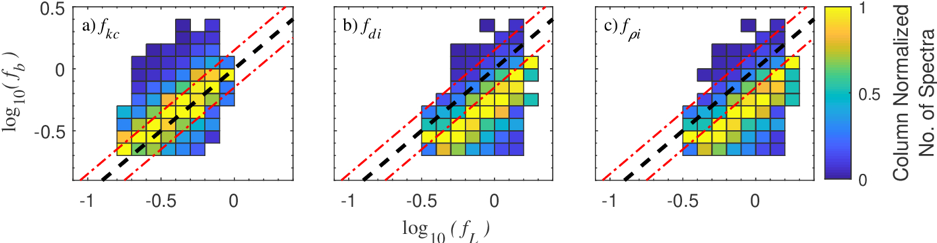
Histograms for 2012 of the estimated helicity onset frequency, fb, versus the three characteristic plasma scales, converted into frequencies using Taylor's hypothesis - fL represents fkc, fdi, and fρi, for each column respectively. The data used are for periods where 0.95 ≥ βi,perp ≥ 1.05. The colour-bar represents the column-normalised number of spectra. The black dashed lines represent fb = fL and similarly, the red dashed lines are fb = fL/ √2 and fb = fL√2, which give the resolution of the wavelet transform about the line fb = fL due to the finite width of the Morlet wavelet in frequency space. We see the best agreement between fb and fkc during these periods.
We also find that the coherent magnetic helicity signature observed at these frequencies is bounded at low frequencies by 1/kc and its absolute value reaches a maximum at ρi. These results hold in both slow and fast wind streams, but with a better correlation in the more Alfvénic fast wind where the helicity signature is strongest. We conclude that these findings are consistent with proton-cyclotron resonance as an important mechanism for dissipation of turbulent energy in the solar wind, occurring at least half the time in our selected interval. However, we do not rule out additional mechanisms.