MIST
Magnetosphere, Ionosphere and Solar-Terrestrial
Latest articles
- Introducing XIM to Study the Spectral Properties of Solar Wind Charge Exchange at Earth’s Magnetospheric Boundaries
- Saturn's Auroral Dusk Sector Magnetosphere-Ionosphere Coupling During Cassini's Proximal Orbits
- A Multi-Event Comparison of dB/dt Resulting From Omega Band Aurora
- Can we Resolve Magnetosheath Jets with a Soft X-ray Imager?
- Russell-McPherron mechanism effect on space junk de-orbiting
Latest news
2026 MIST Council Election Results
It is our pleasure to announce the results of the latest MIST Council Election.
- Samuel Wharton (University of Leicester) is elected for a 3 year term as a MIST Councillor
- Jewel Abbey Relampagos (Lancaster University) is elected for a 1 year term as the MIST Student Representative
In addition, due to concerns from the community regarding the ongoing UKRI/STFC funding situation, MIST Council have also decided to charter Mark Lester (University of Leicester) as an additional councillor to inform and steer the council in matters related to this specific brief, as set out in Article 4.5 of the MIST Charter.
We would like to congratulate everyone on their new roles. The full composition of Council can be found on the MIST website (https://www.mist.ac.uk/community/mist-council). We would like to thank all the candidates for putting themselves forward and everyone who took part in the voting. We received votes from 132 people which represents a turnout of 21.5% of people registered to receive the MIST emailing list.
Finally, MIST Council would like to extend their thanks and gratitude to our outgoing members: Fiona Ball and Georgios Nicolaou. We would also like to say a special thank you to Andy Smith who was co-opted to be on MIST council while Rosie Johnson was on maternity leave, thank you for all of your hard work.
Open Letter Ready For Signatories
Protect MIST Science! Sign the MIST Community Open Letter on the STFC funding cuts!
https://sites.google.com/view/uk-mist-community-open-letter
Statement from MIST Council regarding the STFC Funding Situation
Statement from MIST Council regarding the STFC Funding Situation
MIST Council is deeply concerned by the ongoing STFC funding uncertainty and its impact on our community and beyond.
The current combination of prospective delayed and reduced funding, together with already volatile financial situations at universities across the UK, is placing significant strain on research groups. In some cases, institutions may be unable to support researchers through gaps between projects, increasing precarity across the community and adding significant pressure on early-career researchers.
We are concerned that continued uncertainty risks accelerating a brain drain from the UK, as skilled researchers reconsider their future in a system offering limited stability. The loss of expertise at any career stage would have lasting consequences for UK space science.
What is going on?
For those that are unaware of the situation, it is complex and evolving. We suggest the following sources to get up to speed on the current developments.
https://ras.ac.uk/news-and-press/news/proposed-budget-cuts-catastrophe-uk-astronomy
What are we doing about it?
Behind the scenes, MIST Council is actively engaging with relevant parties to understand the scale of the challenge and to identify constructive ways forward.
- We are seeking seasoned members of the community to join MIST Council on a task force to help develop options and represent the needs of our community. If you would like to be involved, please reach out to us via the MIST Council email (This email address is being protected from spambots. You need JavaScript enabled to view it.) by the end of this week (13th February 2026).
- In addition to the task force, we want to provide an open forum for discussion and collective input among all members of the wider MIST community. We are exploring options and will be in touch as soon as possible with further details.
- We believe in working together in the face of the current challenges and we are collaborating with UKSP and others to strive for a fair and positive outcome for all. We are reaching out to members of the SSAP (Solar System Advisory Panel) to explore the hosting of a community town hall meeting, like the one already being organised by the AAP (Astronomy Advisory Panel), to provide an open forum for discussion and collective input.
What can you do to help?
There are several open letters representing people in various career stages that have been made available to sign. We encourage you to read the relevant letter(s) and to sign them if you support them:
- Fellowship Holders: https://advancedfellows-openletter-stfc.github.io/index.html
- Early Career Researchers: https://ecr-openletter-stfc.github.io/
The Royal Astronomical Society are also urging Fellows to lobby their MPs against the cuts, and have included a template letter that can be used to do so:
https://ras.ac.uk/news-and-press/news/ras-fellows-urged-lobby-against-unprecedented-cuts
MIST Council will continue to advocate for transparency, stability, and funding structures that recognise both the long-term nature of our science and the people who deliver it.
We thank you for your continued support in this period of uncertainty.
Please contact This email address is being protected from spambots. You need JavaScript enabled to view it. if you have further suggestions.
MIST Council

Announcement of New MIST Council 2025
We are very pleased to announce the following members of the community have been elected to MIST Council:
- Gemma Bower (University of Leicester), MIST Councillor
- Tom Elsden (University of St Andrews), MIST Councillor
- Cameron Patterson (Lancaster University), MIST Councillor
- Fiona Ball (University of Southampton), Student Representative
They will begin their terms in July 2025.
We thank outgoing MIST Council members: Maria Walach, Chiara Lazzeri and Emma Woodfield. Andy Smith will remain on council a little longer as a co-opted member to cover Rosie Johnson's maternity leave.
The current composition of Council can be found on our website (https://www.mist.ac.uk/community/mist-council).
Announcement of New MIST Councillors.
We are very pleased to announce the following members of the community have been elected unopposed to MIST Council:
- Rosie Johnson (Aberystwyth University), MIST Councillor
- Matthew Brown (University of Birmingham), MIST Councillor
- Chiara Lazzeri (MSSL, UCL), Student Representative
Rosie, Matthew, and Chiara will begin their terms in July. This will coincide with Jasmine Kaur Sandhu, Beatriz Sanchez-Cano, and Sophie Maguire outgoing as Councillors.
The current composition of Council can be found on our website, and this will be amended in July to reflect this announcement (https://www.mist.ac.uk/community/mist-council).
Nuggets of MIST science, summarising recent papers from the UK MIST community in a bitesize format.
If you would like to submit a nugget, please fill in the following form: https://forms.gle/DGNZiP7sA3e8U29ZA and we will arrange a slot for you in the schedule. Nuggets should be 100–300 words long and include a figure/animation. Please get in touch!
If you have any issues with the form, please contact This email address is being protected from spambots. You need JavaScript enabled to view it..
Observations of magnetic reconnection in Earth’s bow shock
by Imogen Gingell (Imperial College London)
The bow shock is a thin transition between super-sonic solar wind flows and sub-sonic flows in the Earth’s magnetosheath, during which the plasma is rapidly compressed and heated. In space plasmas, particle collisions cannot provide sufficient energy dissipation to slow the flow to sub-sonic speeds. Instead, nonlinear, electromagnetic plasma processes must be responsible.
Recent simulations (hybrid and fully kinetic particle-in-cell) have shown that current sheets and magnetic islands may be generated within the bow shock’s thin transition region (see Gingell et al 2017). This implies that magnetic reconnection, i.e. a localised change in the topology of the magnetic field, may be among the nonlinear processes responsible for heating in the shock transition layer. However, reconnection is not currently included in shock models.
Using data provided by NASA’s Magnetospheric Multiscale mission (MMS), we have now detected signatures of reconnection occurring at current sheets embedded in the shock. These signatures include a reversal of the magnetic field direction over ion inertial scales and a coincident super-Alfvénic jet of electrons corresponding the outflow from the reconnection site (see Fig 1). The increase in the electron temperature is consistent with previous observations of reconnection at the magnetopause. However, the lack of an ion jet or heating is similar to recent observations within the magnetosheath.
Now that we have confirmed that reconnection can occur within the bow shock, we must assess the broader impact of reconnection on heating and particle acceleration at shocks, explore the evolution of reconnecting structures as they convect downstream, and determine the parameter regime over which shock reconnection can occur.
For more information, please see the paper below:
Gingell, I., Schwartz, S. J., Eastwood, J. P., Burch, J. L., Ergun, R. E., Fuselier, S., et al. (2019). Observations of magnetic reconnection in the transition region of quasi‐parallel shocks. Geophysical Research Letters, 46. https://doi.org/10.1029/2018GL081804
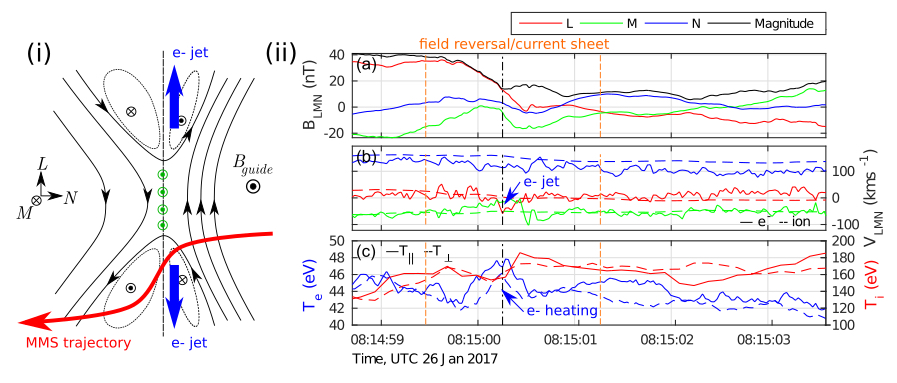
Fig 1. (i) schematic of the structure of a reconnecting current sheet, showing magnetic field (black), current density (green), electron outflow jets (blue) and spacecraft trajectory for the observed event (red). (ii) observations of a current sheet in the bow shock, showing (a) magnetic field, (b) electron and ion bulk velocities, and (c) electron ion temperatures.
The surprisingly variable current system inside Saturn’s D ring
by Gabby Provan & Stan Cowley (University of Leicester)
During Cassini’s Grand Finale, the spacecraft made 22 daring “proximal” periapsis passes between the denser layers of Saturn’s upper atmosphere and the inner edge of the planet’s innermost D ring (Figure 1a). This region had never previously been explored. On every pass Cassini’s magnetometer observed unanticipated perturbations in the azimuthal magnetic field component, confined to field lines that pass through and inside of the D ring in the equatorial plane, peaking typically at a few tens of nano-Tesla. Since the fields are near-symmetric about the magnetic equator, they are consistent with interhemispheric currents flowing along the near-equatorial magnetic field lines, as illustrated in Figure 1b.
Here we examine the azimuthal field perturbations on all the proximal passes, and show that they are surprisingly variable in form and magnitude. While a third of the passes indicate a unidirectional current flow, and a further third shows multiple sheets of oppositely-directed currents. The remaining passes present diverse signatures, including two passes showing reverse currents, and two with only small and fluctuating perturbations. This variability is not related to the spacecraft trajectory or organized by any known rotational period of the Saturnian system (i.e. the phase of the Saturn’s planetary period oscillations or the rotational phase of the D68 ringlet).
Khurana et al. (2018) suggested that these currents are generated by differential zonal thermospheric wind drag acting in the ionosphere at the two ends of these inner field lines. If so, these results show that either Saturn’s ionospheric zonal winds or ionospheric conductivity, or both, are very variable over the ~6.5 day orbital period of these periapsis passes. Our results add to the body of evidence showing that there is a significant and variable dynamical interaction between the material in Saturn’s D ring and the planet’s equatorial atmosphere.
For more information, please see the paper below:
Provan, G., Cowley, S. W. H., Bunce, E. J., Bradley, T. J., Hunt, G. J., Cao, H., & Dougherty, M. K. (2019). Variability of intra–D ring azimuthal magnetic field profiles observed on Cassini's proximal periapsis passes. Journal of Geophysical Research: Space Physics, 124. https://doi.org/10.1029/2018JA026121
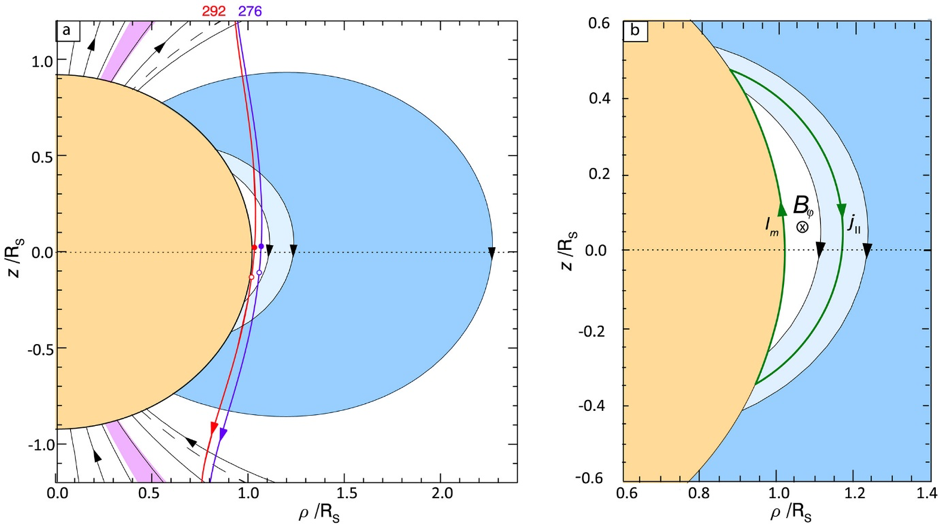
Figure 1: (a) The spacecraft trajectory of two example proximal passes. The planet is shown in orange, and the arrowed black lines show model magnetic field lines. The A to C rings are shown in dark blue, and the D ring in lighter blue. The suggested intra-D ring current system is shown in green in panel (b).
Field line resonance in the Hermean magnetosphere: structure and implications for plasma distribution
by Matthew K. James (University of Leicester)
Mercury’s magnetosphere is the smallest and most active within our solar system, providing a unique laboratory for studying magnetospheric physics, where much can be ascertained using ultra low frequency (ULF) waves. ULF waves are a key mechanism in the transmission of energy, momentum and information around any magnetised plasma environment and have been observed in magnetospheres throughout the solar system (e.g. Mercury, Earth, Jupiter, Saturn and Ganymede). The frequencies and polarizations of a certain class of ULF waves, called magnetohydrodynamic shear Alfvén waves, can be used to diagnose the plasma mass loading within the magnetosphere. Shear Alfvén waves are transverse standing waves which exist on field lines bound at both ends to the planet in question, where the perturbed magnetic field is displaced azimuthally around the planetary magnetosphere. These waves are analogous to the waves standing on a guitar string, where only standing waves with discrete frequencies are supported. At Earth, these waves are often driven by solar wind forcing on the magnetosphere in a process known as field line resonance (FLR).
Until recently, it was thought that Mercury's magnetosphere was incapable of supporting such FLRs due to its relatively small size. Our study is the first statistical survey of FLRs in the Hermean magnetosphere; we used magnetic field observations from the spacecraft MESSENGER to detect 566 FLRs within the dayside of the magnetosphere. An example simulation of one such Hermean FLR is presented in the figure below, where the field oscillates with a combination of both the fundamental and second harmonic frequencies.The characteristics of these waves were used to determine plasma mass densities throughout the dayside magnetosphere. We also found that the structure of the resonant waves is highly asymmetric about the magnetic equator, with the largest field perturbations appearing north of the magnetic equator due to the offset of the magnetic dipole into the northern hemisphere of the planet.
For more information, please see the paper below:
James, M. K., Imber, S. M., Yeoman, T. K., & Bunce, E. J. (2019). Field line resonance in the Hermean magnetosphere: Structure and implications for plasma distribution. Journal of Geophysical Research: Space Physics, 124. https://doi.org/10.1029/2018JA025920
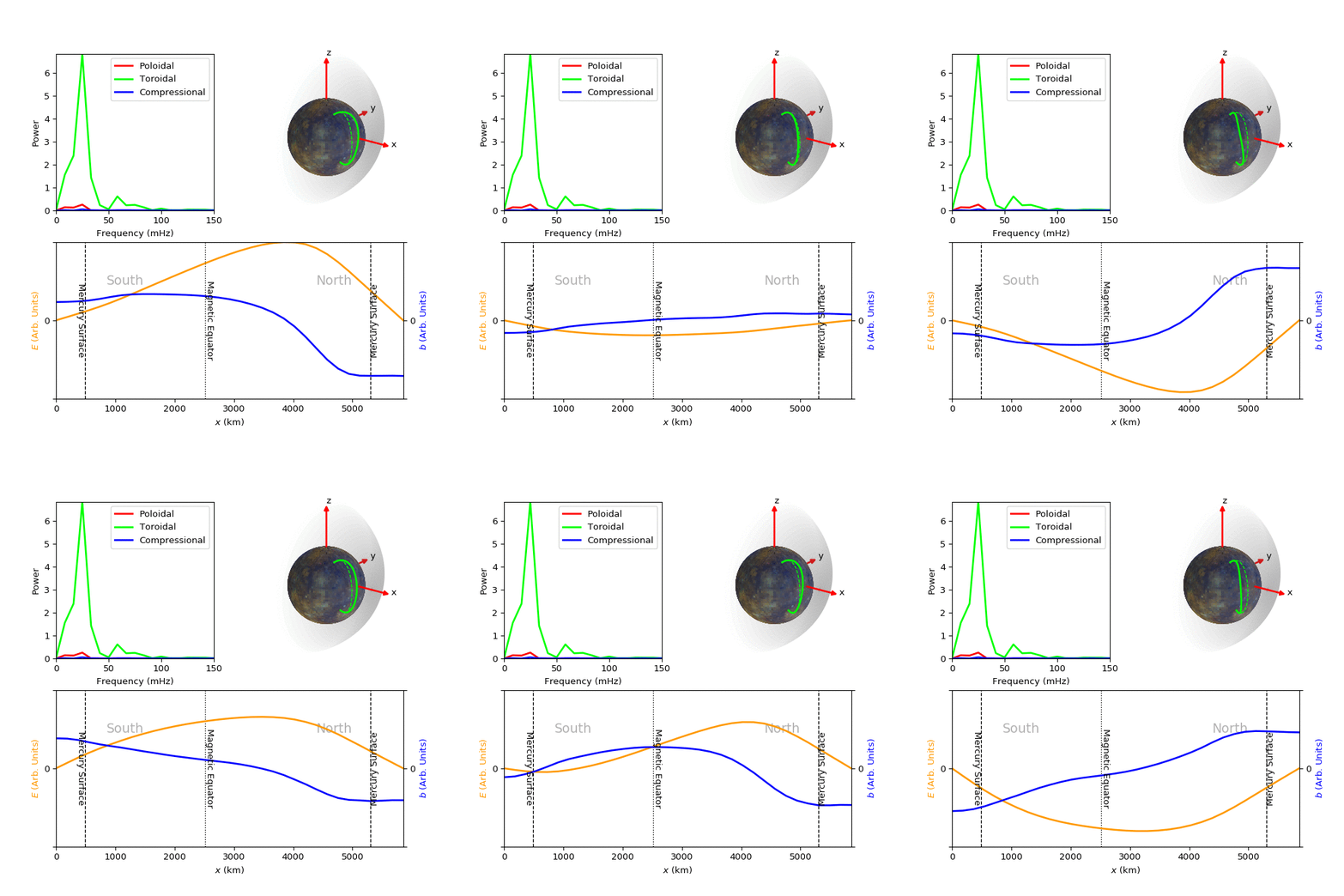
Figure: Top left panel shows the power spectrum of the poloidal (red), toroidal (green) and compressional (blue) components of a FLR detected using MESSENGER. The majority of the wave power is seen in the toroidal component at 25 mHz (fundamental frequency), some toroidal wave power is also present at 60 mHz (second harmonic). The top right panel is an animation showing how the displacement of the field line (solid green line) might vary with time, compared to the unperturbed field (dashed green line), as it oscillates with a combination of the two detected frequencies at the location of this resonance. The bottom panel contains an animation showing how the electric (yellow) and magnetic perturbation (blue) fields would vary in time along the length of the field line, x.
Measuring a geomagnetic storm with a Raspberry Pi magnetometer
by Ciarán Beggan (British Geological Survey)
As computers such as the Raspberry Pi and geophysical sensors have become smaller and cheaper it is now possible to build a reasonably sensitive system which can detect and record the changes of the magnetic field caused by the Northern Lights (aurora). Though not as accurate as a scientific level instrument, the Raspberry Pi magnetometer costs around 1/100th the price (about £180 at 2019 prices) for around 1/100th the accuracy (~1.5 nanoTesla). However, this is sufficient to make interesting scientific measurements.
During 2017, a network of 9 Raspberry Pi magnetometers were deployed to schools around the UK from Benbecula to Norwich. On the 8th September 2017 a large geomagnetic storm was captured by the school magnetometers. Using these data and the array of other magnetometers around the North Sea, we were able to recreate the spatial and temporal changes of the magnetic field during the storm in great detail. The two phases of the storm (see Figure) show the westward (night time) and eastward (daytime) flow of the auroral electrojet currents in the ionosphere.
The results are given in more detail in our paper, but we have shown that it is possible to augment the existing professional network with citizen science sensors to fill in the ‘gaps’ for large geomagnetic storms.
Please see the paper below for more information:
Beggan, C. D. and Marple, S. R. (2018), Building a Raspberry Pi school magnetometer network in the UK, Geosci. Commun., 1, 25-34, https://doi.org/10.5194/gc-1-25-2018
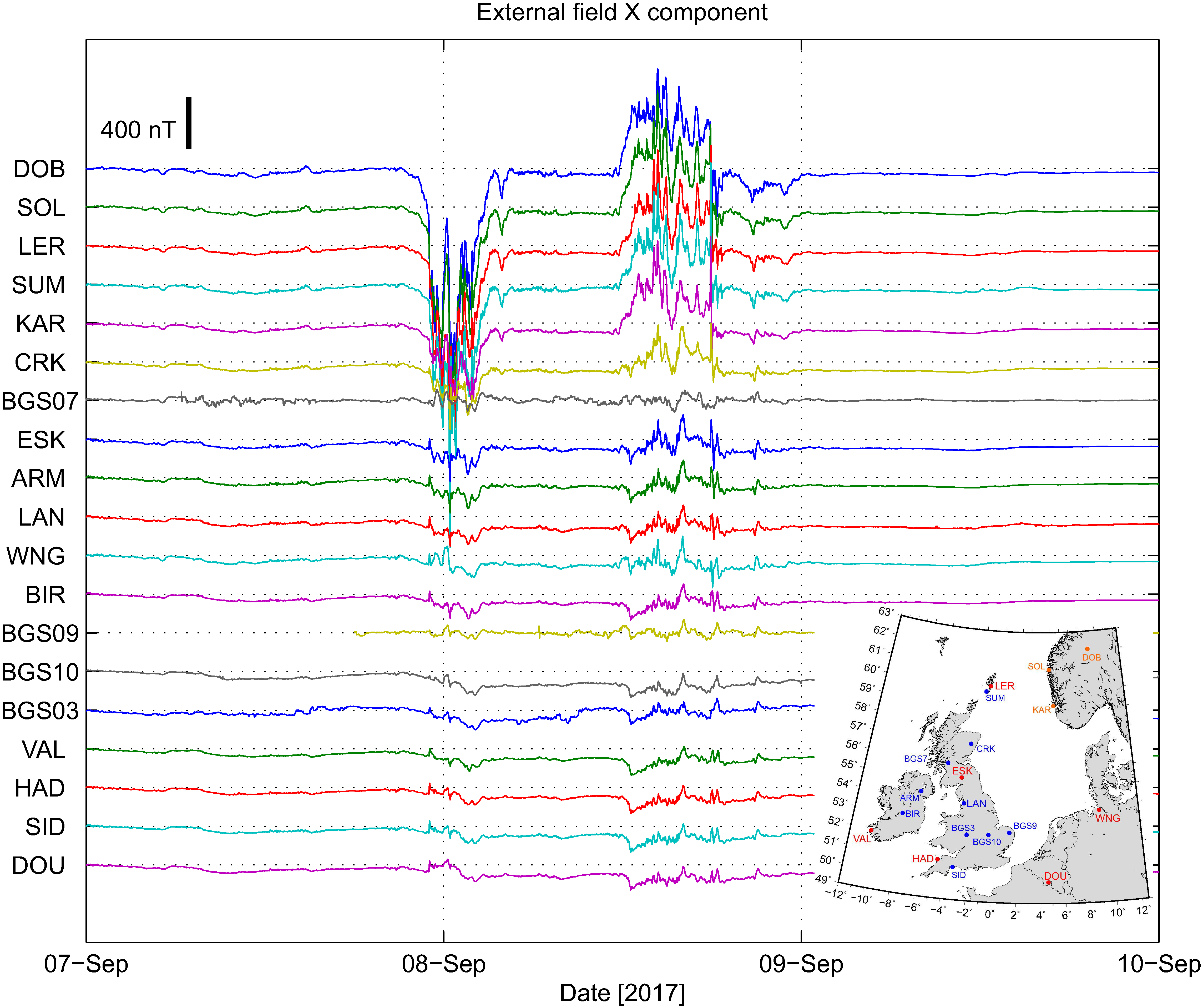
Figure: Stackplot of the variation of the magnetic North component of the magnetic field for the geomagnetic storm of the 7-8th September 2017, ordered by latitude. Inset: Map of the locations of the variometers and observatories around the North Sea.
Statistical Planetary Period Oscillation Signatures in Saturn's UV Auroral Intensity
by Alexander Bader, Lancaster University, UK.
Saturn's highly dynamic auroras are generated by electrons precipitating along the magnetic field lines into the planet's polar ionospheres due to currents along the magnetic field lines. Therefore, the aurora provide information about the location and strength of these field-aligned currents. Two types of large-scale current systems have been observed in magnetic field measurements: one a quasi-static system associated with flow shears between plasma rotating at different speeds in the outer magnetosphere. The other significant type are field-aligned current systems rotating according to the planetary period oscillation (PPO) systems. Both the northern and the southern hemisphere are associated with one such system each, superimposed on the quasistatic system and causing roughly 10.7-hour periodic oscillations throughout the Kronian magnetosphere.
Upward and downward field-aligned currents in the northern ionosphere were found to be modulated by rotating patterns imposed by both the northern and southern PPO systems, the latter modulation being facilitated through interhemispheric current closure. The auroral intensity is hence also expected to be modulated accordingly, such that the northern aurora is brightest at roughly ΨN/S = 90°, where the currents have also been shown to maximize. Due to the two PPO systems rotating at slightly different angular velocities, this results in a double modulation.
In this study we analyzed the statistical behavior of Saturn's ultraviolet auroral emissions over the full Cassini mission using all suitable Cassini-UVIS images acquired between 2007 and 2017. This study shows for the first time that both hemispheres' auroral intensities are modulated by both the PPO system associated with the same hemisphere (primary system, Fig. 1a) and the opposite hemisphere (secondary system, Fig. 1b), relatively. The modulation by the primary system is found to be more intense than the one caused by the secondary system. This confirms that both PPO systems' field-aligned currents traverse the entire magnetosphere and close at least partly in the hemisphere opposite to where the generating perturbation is located.
For more information, see our paper below:
Bader, A., Badman, S. V., Kinrade, J., Cowley, S. W. H., Provan, G., & Pryor, W. R. (2018). Statistical planetary period oscillation signatures in Saturn's UV auroral intensity. Journal of Geophysical Research: Space Physics, 123, 8459–8472. https://doi.org/10.1029/2018JA025855

Figure 1: Average northern UV auroral intensity maxima per local time (4/3 h bin size) and PPO phase ΨN/S (20° bin size), shown in a logarithmic color scale. (a) Northern hemisphere auroral intensity ordered by the northern PPO system and (b) northern hemisphere auroral intensity ordered by the southern PPO system. Two Ψ phase cycles are plotted for clarity, the expected locations of maximum upward current are indicated by dashed white lines. On the top and to the side of each 2D histogram the averages of the mean intensity maxima over the ΨN/S and LT dimensions are shown in black, respectively. Separate histograms showing the PPO intensity modulation in the dawn-noon (blue) and dusk-midnight (red) regions are calculated from the parts of the histogram marked with colored boxes and shown to the right side (note the logarithmic intensity scale). The histogram over the full LT range (black) has been fitted with a simple sine (gray). Its maxima are marked with vertical dash-dotted lines, its peak-to-peak (pk-pk) amplitude and the ΨN angle with the highest intensity are given in the top right corner of each panel.