MIST
Magnetosphere, Ionosphere and Solar-Terrestrial
Latest articles
- Introducing XIM to Study the Spectral Properties of Solar Wind Charge Exchange at Earth’s Magnetospheric Boundaries
- Saturn's Auroral Dusk Sector Magnetosphere-Ionosphere Coupling During Cassini's Proximal Orbits
- A Multi-Event Comparison of dB/dt Resulting From Omega Band Aurora
- Can we Resolve Magnetosheath Jets with a Soft X-ray Imager?
- Russell-McPherron mechanism effect on space junk de-orbiting
Latest news
2026 MIST Council Election Results
It is our pleasure to announce the results of the latest MIST Council Election.
- Samuel Wharton (University of Leicester) is elected for a 3 year term as a MIST Councillor
- Jewel Abbey Relampagos (Lancaster University) is elected for a 1 year term as the MIST Student Representative
In addition, due to concerns from the community regarding the ongoing UKRI/STFC funding situation, MIST Council have also decided to charter Mark Lester (University of Leicester) as an additional councillor to inform and steer the council in matters related to this specific brief, as set out in Article 4.5 of the MIST Charter.
We would like to congratulate everyone on their new roles. The full composition of Council can be found on the MIST website (https://www.mist.ac.uk/community/mist-council). We would like to thank all the candidates for putting themselves forward and everyone who took part in the voting. We received votes from 132 people which represents a turnout of 21.5% of people registered to receive the MIST emailing list.
Finally, MIST Council would like to extend their thanks and gratitude to our outgoing members: Fiona Ball and Georgios Nicolaou. We would also like to say a special thank you to Andy Smith who was co-opted to be on MIST council while Rosie Johnson was on maternity leave, thank you for all of your hard work.
Open Letter Ready For Signatories
Protect MIST Science! Sign the MIST Community Open Letter on the STFC funding cuts!
https://sites.google.com/view/uk-mist-community-open-letter
Statement from MIST Council regarding the STFC Funding Situation
Statement from MIST Council regarding the STFC Funding Situation
MIST Council is deeply concerned by the ongoing STFC funding uncertainty and its impact on our community and beyond.
The current combination of prospective delayed and reduced funding, together with already volatile financial situations at universities across the UK, is placing significant strain on research groups. In some cases, institutions may be unable to support researchers through gaps between projects, increasing precarity across the community and adding significant pressure on early-career researchers.
We are concerned that continued uncertainty risks accelerating a brain drain from the UK, as skilled researchers reconsider their future in a system offering limited stability. The loss of expertise at any career stage would have lasting consequences for UK space science.
What is going on?
For those that are unaware of the situation, it is complex and evolving. We suggest the following sources to get up to speed on the current developments.
https://ras.ac.uk/news-and-press/news/proposed-budget-cuts-catastrophe-uk-astronomy
What are we doing about it?
Behind the scenes, MIST Council is actively engaging with relevant parties to understand the scale of the challenge and to identify constructive ways forward.
- We are seeking seasoned members of the community to join MIST Council on a task force to help develop options and represent the needs of our community. If you would like to be involved, please reach out to us via the MIST Council email (This email address is being protected from spambots. You need JavaScript enabled to view it.) by the end of this week (13th February 2026).
- In addition to the task force, we want to provide an open forum for discussion and collective input among all members of the wider MIST community. We are exploring options and will be in touch as soon as possible with further details.
- We believe in working together in the face of the current challenges and we are collaborating with UKSP and others to strive for a fair and positive outcome for all. We are reaching out to members of the SSAP (Solar System Advisory Panel) to explore the hosting of a community town hall meeting, like the one already being organised by the AAP (Astronomy Advisory Panel), to provide an open forum for discussion and collective input.
What can you do to help?
There are several open letters representing people in various career stages that have been made available to sign. We encourage you to read the relevant letter(s) and to sign them if you support them:
- Fellowship Holders: https://advancedfellows-openletter-stfc.github.io/index.html
- Early Career Researchers: https://ecr-openletter-stfc.github.io/
The Royal Astronomical Society are also urging Fellows to lobby their MPs against the cuts, and have included a template letter that can be used to do so:
https://ras.ac.uk/news-and-press/news/ras-fellows-urged-lobby-against-unprecedented-cuts
MIST Council will continue to advocate for transparency, stability, and funding structures that recognise both the long-term nature of our science and the people who deliver it.
We thank you for your continued support in this period of uncertainty.
Please contact This email address is being protected from spambots. You need JavaScript enabled to view it. if you have further suggestions.
MIST Council

Announcement of New MIST Council 2025
We are very pleased to announce the following members of the community have been elected to MIST Council:
- Gemma Bower (University of Leicester), MIST Councillor
- Tom Elsden (University of St Andrews), MIST Councillor
- Cameron Patterson (Lancaster University), MIST Councillor
- Fiona Ball (University of Southampton), Student Representative
They will begin their terms in July 2025.
We thank outgoing MIST Council members: Maria Walach, Chiara Lazzeri and Emma Woodfield. Andy Smith will remain on council a little longer as a co-opted member to cover Rosie Johnson's maternity leave.
The current composition of Council can be found on our website (https://www.mist.ac.uk/community/mist-council).
Announcement of New MIST Councillors.
We are very pleased to announce the following members of the community have been elected unopposed to MIST Council:
- Rosie Johnson (Aberystwyth University), MIST Councillor
- Matthew Brown (University of Birmingham), MIST Councillor
- Chiara Lazzeri (MSSL, UCL), Student Representative
Rosie, Matthew, and Chiara will begin their terms in July. This will coincide with Jasmine Kaur Sandhu, Beatriz Sanchez-Cano, and Sophie Maguire outgoing as Councillors.
The current composition of Council can be found on our website, and this will be amended in July to reflect this announcement (https://www.mist.ac.uk/community/mist-council).
Nuggets of MIST science, summarising recent papers from the UK MIST community in a bitesize format.
If you would like to submit a nugget, please fill in the following form: https://forms.gle/DGNZiP7sA3e8U29ZA and we will arrange a slot for you in the schedule. Nuggets should be 100–300 words long and include a figure/animation. Please get in touch!
If you have any issues with the form, please contact This email address is being protected from spambots. You need JavaScript enabled to view it..
SuperDARN Observations During Geomagnetic Storms, Geomagnetically Active Times, and Enhanced Solar Wind Driving
by Maria-Theresia Walach (Lancaster University)
At Earth, solar wind coupling drives large scale convection of field lines: antisunward flow of open field lines at high latitudes and the return flow of closed field lines at lower latitudes. This convection can be observed through measurements of the ionosphere, for example using measurements from SuperDARN, an international network of ground based radars, purposely built to study ionospheric convection. We use 7 years of Super Dual Auroral Radar (SuperDARN) data to study ionospheric convection during geomagnetic storms, geomagnetically active times and solar wind driven times. Using the most recent years of SuperDARN data allows us to study ionospheric convection at the mid-latitudes with a field-of-view spanning from the pole to 40 degrees of magnetic latitude.
In this study, we address a number of questions; for example, do we make similar SuperDARN observations during similar solar wind driving during nonstorm time as during storm time? Do SuperDARN observations change throughout the different phases of a storm? Where do we see the fastest flows with SuperDARN, and is it linked to the extent of latitudinal coverage from the radars? Does the latitudinal range of the convection, given, for example, by the return flow region, stay constant throughout a storm? We find that initial and recovery phases of geomagnetic storms show similar convection as enhanced solar wind driving when no geomagnetic storm occurs.
One of the key findings showing the change of regime between the initial, main, and recovery phase of the storm is shown in the figure: it shows the varying relationship between the flow reversal boundary (here FRB but otherwise known as the open-closed field line boundary or polar cap boundary) and the Heppner-Maynard boundary (here HMB, which corresponds to the lower latitude boundary where the ionospheric convection electric field approaches 0 kV). The blue line shows the line of best fit and the data distribution along it, indicates that the boundaries must expand and contract together, however, this happens at different rates during the different storm phases, producing an inflated return flow region during the main phase of the storm.
For more information, please see the paper below:
, & ( 2019). SuperDARN observations during geomagnetic storms, geomagnetically active times, and enhanced solar wind driving. Journal of Geophysical Research: Space Physics, 124. https://doi.org/10.1029/2019JA026816
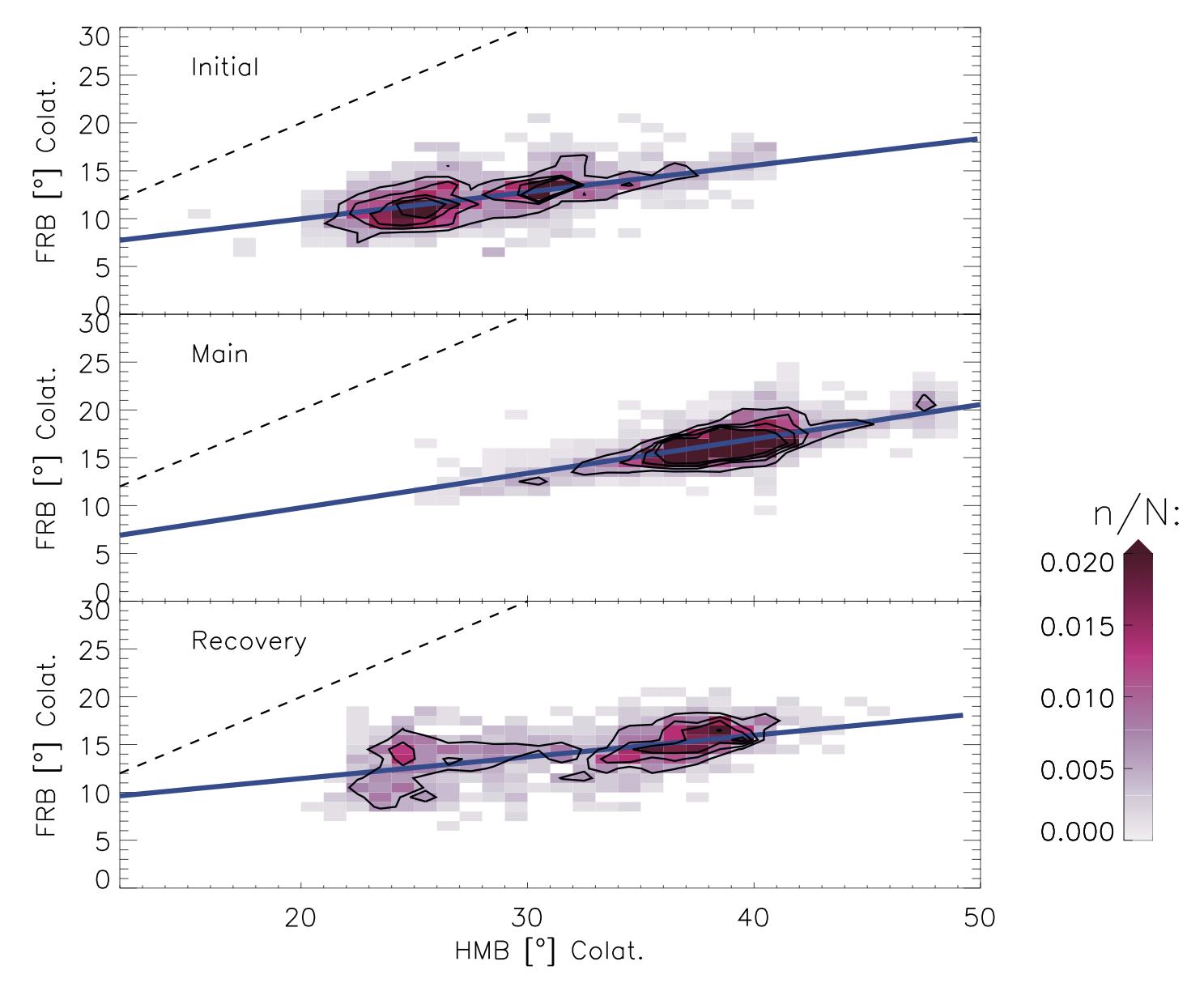
Figure: Colatitude location of the flow reversal boundary (FRB) against the Heppner‐Maynard boundary (HMB) during the three phases of geomagnetic storms (only using maps where n ≥ 200). The dashed black lines show the line of unity and the black contours correspond to where the normalized data point density corresponds to 0.005, 0.01, 0.015, and 0.02.
Exploring Key Characteristics in Saturn’s Infrared Auroral Emissions Using VLT-CRIRES: H3+ Intensities, Ion Line-of-Sight Velocities, and Rotational Temperatures
by Nahid Chowdhury (University of Leicester)
Saturn’s aurorae are generated by interactions between high-energy charged particles and neutral atoms in the upper atmosphere. Infrared observations of auroral emissions make use of H3+ – a dominant hydrogen ion in Saturn’s ionosphere – that acts as a tracer of energy injected into the ionosphere.
We analysed observations taken in May 2013 of Saturn’s northern infrared auroral emissions with the Very Large Telescope in Chile using the CRIRES instrument. The use of adaptive optics, combined with the high spectral resolution of VLT-CRIRES (100,000), meant that this dataset offered an unprecedented spatially and spectrally resolved ground-based view of Saturn's infrared aurora. Using discrete H3+ emission lines, we derived dawn-to-dusk auroral emission intensity, ion line-of-sight velocity, and thermospheric temperature profiles, allowing us to probe the physical properties of Saturn’s polar atmosphere.
Our analysis showed an enhancement in the dawn-side auroral emission intensity, a common feature that is known to be linked with solar-wind compressions in the kronian magnetosphere, and the presence of a localised dark region in the aurora very close to the pole. The ion line-of-sight velocity profile revealed previously unknown smaller-scale structures in the ion flows. In particular, the ion flows near the centre of the pole (at position B in Figure 1) could be consistent with the behaviour of a relatively small ionospheric polar vortex whereby the ions are interrupting the general dawn-to-dusk trend in movement to instead adopt a very sharp shearing motion of ions first toward midnight and then almost immediately back toward noon. Our thermospheric temperature derivations also reveal a very subtle temperature gradient that increases from 350 K on the dawn-side of the pole to 389 K on the dusk-side.
This work has bought to light complex features in the behaviour of H3+ ions in Saturn’s upper atmosphere for the first time and highlights the need for additional analyses of two-dimensional scanned maps of Saturn’s auroral regions with a view to addressing some of the major outstanding questions surrounding Saturn’s thermosphere-ionosphere-magnetosphere interaction.
For more information, please see the paper below:
, , , & ( 2019). Exploring key characteristics in Saturn's infrared auroral emissions using VLT‐CRIRES: H3+intensities, ion line‐of‐sight velocities, and rotational temperatures. Geophysical Research Letters, 46. https://doi.org/10.1029/2019GL083250.
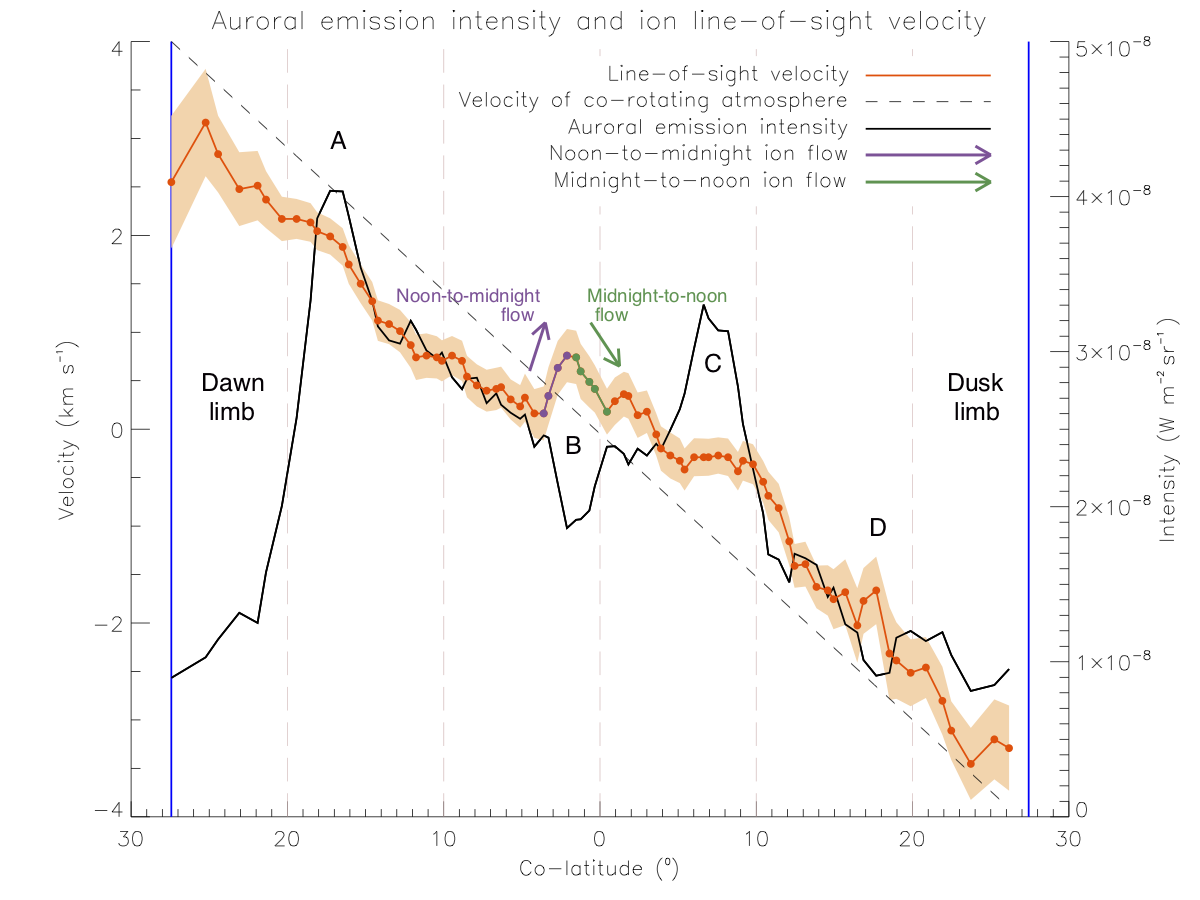
Figure 1: The ion line-of-sight velocity and auroral emission intensity profiles are plotted as a function of co-latitude on the planet. Evidence for ion flows possibly consistent with the behaviour of an intriguing ionospheric polar vortex is adjacent to the area marked by the letter B, between approximately 0⁰ and 5⁰ co-latitude on the dawn-side of Saturn’s northern pole.
Directed network of substorms using SuperMAG ground-based magnetometer data
by Lauren Orr (University of Warwick)
Space weather can cause large-scale currents in the ionosphere which generate disturbances of magnetic fields on the ground. These are observed by >100 magnetometer stations on the ground. Network analysis can extract the important information from these many observations and present it as a few key parameters that indicate how severe the ground impact will be. We quantify the spatio-temporal evolution of the substorm ionospheric current system utilizing the SuperMAG 100+ magnetometers, constructing dynamical directed networks from this data for the first time.
Networks are a common analysis tool in societal data, where people are linked based on various social relationships. Other examples of networks include the world wide web, where websites are connected via hyperlinks, or maps where places are linked via roads. We have constructed networks from the magnetometer observations of substorms, where magnetometers are linked if there is significant correlation between the observations. If the canonical cross-correlation (CCC) between vector magnetic field perturbations observed at two magnetometer stations exceeds a threshold, they form a network connection. The time lag at which CCC is maximal, |τC|, determines the direction of propagation or expansion of the structure captured by the network connection. If spatial correlation reflects ionospheric current patterns, network properties can test different models for the evolving substorm current system.
In this study, we select 86 isolated substorms based on nightside ground station coverage. The results are shown for both a single event and for all substorms in the figure. We find, and obtain the timings for, a consistent picture in which the classic substorm current wedge (SCW) forms, quantifying both formation and expansion. A current system is seen pre-midnight following the SCW westward expansion. Later, there is a weaker signal of eastward expansion. Finally, there is evidence of substorm-enhanced magnetospheric convection. These results demonstrate the capabilities of network analysis to understand magnetospheric dynamics and provide new insight into how the SCW develops and evolves during substorms.
For more information please see the paper below:
Orr, L., Chapman, S. C., and Gjerloev, J. W.. ( 2019), Directed network of substorms using SuperMAG ground‐based magnetometer data. Geophys. Res. Lett., 46. https://doi.org/10.1029/2019GL082824
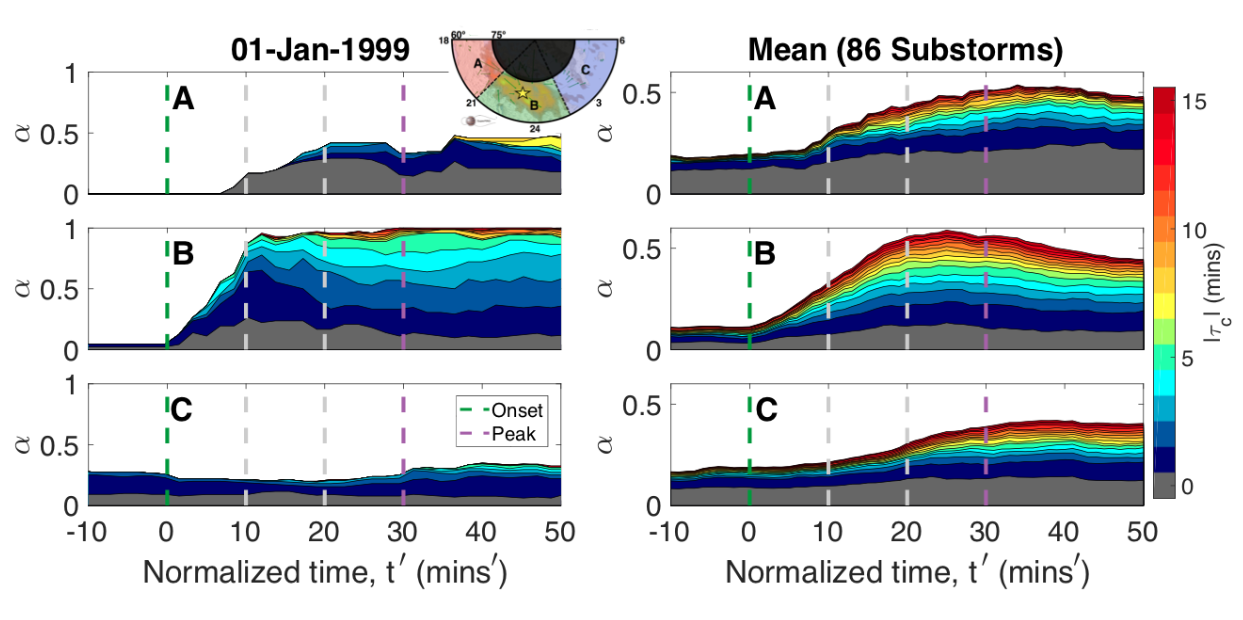
Figure: The normalized number of connections, α(t',τC), is binned by the lag of maximal canonical cross-correlation, |τC|. Each panel stacks, one above the other, α(t',τC) versus normalized time, t’, for |τC|≤15. The regions are indicated on the polar plot and the regions were determined using Polar VIS images of the auroral bulge at the time of maximum expansion. Region B (around onset) exhibits a rapid increase in correlation following substorm onset.
Long-term variations in solar wind parameters, magnetopause location, and geomagnetic activity over the last five solar cycles
by Andrey Samsonov (Mullard Space Science Laboratory, UCL)
The magnetopause is a natural boundary between the solar wind and magnetospheric plasmas. Geosynchronous orbit, where numerous communications, meteorological and GPS satellites operate, is usually located in the magnetosphere but occasionally due to variable solar wind conditions the magnetosphere may significantly compress and those satellites will cross the magnetopause and get in direct contact with the solar wind plasma. Fast streams of dense solar wind plasma as well as solar energetic particles might damage the satellites. Therefore the study of variations of the magnetopause standoff distance is an important problem of space physics. The magnetopause location can be described by empirical models (e.g. Shue et al., 1998; Lin et al., 2010).
In our recent work, we studied long term changes in the magnetopause position. We use both OMNI solar wind observations and empirical magnetopause models to reconstruct time series of the magnetopause standoff distance for nearly five solar cycles (from 1966 to 2018). The magnetopause standoff distance on this time scale depends mostly on the solar wind dynamic pressure (Pdyn). The 11-year solar cycles in the Pdyn variations are superimposed by an increasing trend before 1991 and a decreasing trend between 1991 and 2009. Correspondingly, we find that the standoff distance predicted by magnetopause models increases by nearly 2 RE from 1991 to 2009. The annual sunspot number (SSN), IMF magnitude and magnetospheric geomagnetic activity indices display the same trends as the dynamic pressure. We calculate extreme solar wind parameters and magnetopause standoff distance in each year using daily values and find that both extremely small and large standoff distances during a solar cycle preferably occur at solar maximum rather than at solar minimum (see figure below).
Furthermore, we calculated correlations between annual average solar wind and magnetospheric parameters, and the SSN. The annual IMF magnitude well correlates with SSN with a zero time lag, while the annual Pdyn correlates reasonably well with the SSN but with 3-years time lag. Both the annual solar wind density and velocity well correlate with the dynamic pressure, but the correlation coefficient is higher for density than for velocity. The annual Kp index better correlates with Pdyn, while Dst index better correlates with Bs (negative IMF Bz). This correlation analysis helps to better understand relations between solar, solar wind and magnetospheric parameters on the long time scale.
The knowledge of predicted magnetopause position for the next solar cycle is important for future space missions, especially for those which are intended to observe the dayside magnetopause whether in situ or remotely. One of the forthcoming missions which will study variations of the dayside magnetopause is the Solar Wind Magnetosphere Ionosphere Link Explorer (SMILE).
For more information, please see the paper below:
Samsonov, A. A., Bogdanova, Y. V., Branduardi‐Raymont, G., Safrankova, J., Nemecek, Z., & Park, J.‐S. ( 2019). Long‐term variations in solar wind parameters, magnetopause location, and geomagnetic activity over the last five solar cycles. Journal of Geophysical Research: Space Physics, 124. https://doi.org/10.1029/2018JA026355
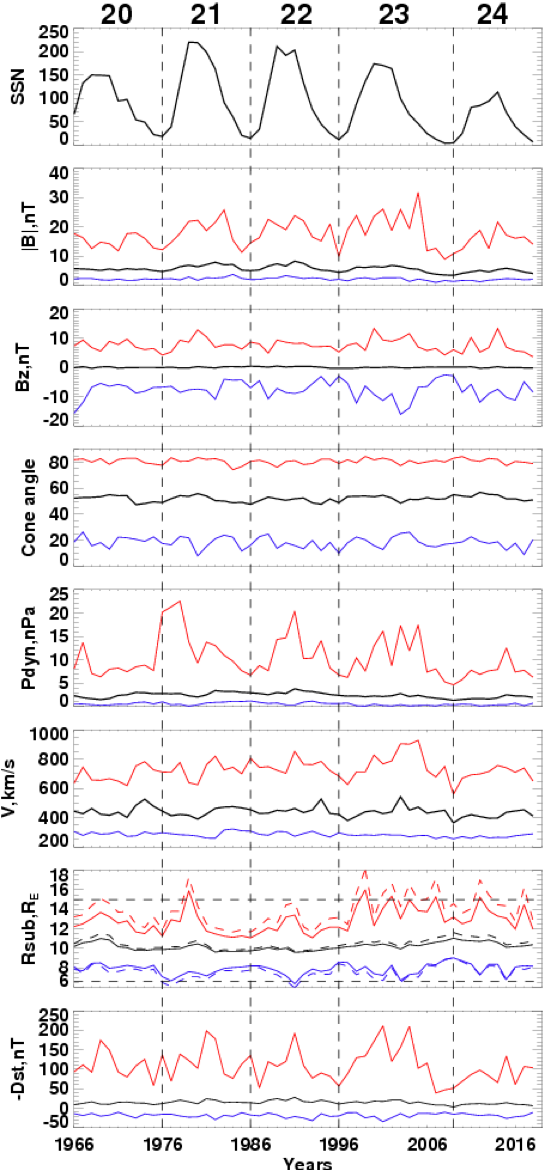
Figure: The sunspot numbers, average and extreme IMF magnitude and Bz, IMF cone angle (the angle between IMF vector and xaxis), solar wind dynamic pressure and velocity, magnetopause standoff distance (solid lines for Shue et al.'s model and dashed lines for Lin et al.'s model), and geomagnetic Dst index. Annual average values shown by black, daily maximal and minimal values for each year shown by red and blue. Vertical lines separate solar cycles as indicated by numbers at the top.
Origin of the extended Mars radar blackout of September 2017
By Beatriz Sánchez-Cano (University of Leicester)
Several instrument operations, as well as communication systems with rovers at the surface, depend on radio signals that propagate throughout the atmosphere of Mars. This is the case for two radars currently operational in Mars’ orbit, sounding the ionosphere, surface and subsurface of the planet: The Mars Advanced Radar for Subsurface and Ionosphere Sounding (MARSIS) on board Mars Express, which operates between 0.1 and 5.5 MHz, and the Shallow Radar (SHARAD) onboard the Mars Reconnaissance Orbiter, which operates at 20 MHz. However, both radars typically suffer from complete blackouts for several days (and even weeks) when solar storms hit Mars. It is thought that an increase in the electron density of the lower ionosphere below 100 km occurs, where even a small enhancement in ionization significantly increases the signal attenuation. In analogy with Earth, some works suggest that solar protons of tens of MeV can cause these absorption layers. However, at Mars, the current origin andlong duration is not known.
Sánchez-Cano et al. (2019) focused on both the MARSIS and SHARAD radar performances during a powerful solar storm that hit Mars in September 2017. The space weather event consisted of a X8.2-class flare emitted by the Active Region 12673 at the western limb of the solar disk on 10 September 2017 (Figure 1a). This was followed by solar energetic particles (ions and electrons) that arrived at Mars few hours later, as recorded by the Mars Atmosphere and Volatile EvolutioN (MAVEN) mission (see Figure 1b,c). Based on MAVEN observations and numerical simulations of energetic electron precipitation, Sánchez-Cano et al. (2019) found that high energy electrons (and not protons) were the main ionization source, creating a dense layer of ions and electrons of magnitude ~1010 m-3 at ~90 km on the Martian nightside. For frequencies between 3 and 20 MHz, the peak absorption level is found at 70 km altitude, and the layer was composed mainly of O2+, the main Martian ionosphere component. This layer attenuated radar signals continuously for 10 days, preventing the radars from receiving any HF signals from the planetary surface across a planetary scale (Figure 1d). This contrasts with the typical few hour durations that these phenomena have at Earth.
This work highlights the need for careful assessments of radar performances for future operational systems, especially during space weather events. During these events, a good characterization of the low ionosphere is necessary for radar operations (and other instruments that use HF radio links), operational planning, as well as for communications with the Martian surface in the HF range.
For more information please see the paper below:
Sánchez‐Cano, B., Blelly, P.‐L., Lester, M., Witasse, O., Cartacci, M., Orosei, R., et al ( 2019). Origin of the extended Mars radar blackout of September 2017. Journal of Geophysical Research: Space Physics, 124. https://doi.org/10.1029/2018JA026403

Figure 1: (a) MAVEN-EUV irradiance observations of wavelength 0.1-7 nm. (b) MAVEN-SEP ion differential flux spectra. (c) MAVEN-SEP electron differential flux spectra. (d) Each symbol denotes when MARSIS and SHARAD were in operation. Empty symbols designate the cases when the surface was observed, and filled symbols when was not observed. The exception are green diamonds that indicate the times when SHARAD observed a highly blurry surface.